Transforming Innovation in a Digital World
At the Laboratory for Innovation Science at Harvard (LISH), we use real-world experimentation and rigorous research to shape how artificial intelligence, digital transformation, and innovation redesign business, science, and society.
Our mission
Is spurring the development of a science of innovation through a systematic program of solving real-world innovation challenges while simultaneously conducting rigorous scientific research and analysis. Our research investigates how digital technologies, especially AI are reshaping innovation, decision-making, and business.
Events
Research Goals
Assessing AI’s Real-World Utility at Companies. While there’s much theoretical discussion about AI’s capabilities, empirical studies that test these technologies in actual businesses exclusive work environments are crucial. Testing various experimental conditions will help determine how AI tools can enhance or detract from productivity and if quality varies across different types of business processes.
Guiding Strategic Implementation: By identifying the conditions under which AI improves or hinders work, these studies provide valuable insights for strategic decision-making. Companies like the ones used in our studies looking to adopt AI technologies need evidence-based guidance on how to do so in a way that enhances their workers’ capabilities rather than replacing them or diminishing their performance.
Shaping Future Workplaces: As AI continues to evolve, understanding its current capabilities and limitations is essential for designing future workplaces. Our research helps in navigating the complexities of integrating AI into knowledge work and contributes to a deeper knowledge base that can helps organizations make informed decisions about where to implement AI.
Manuscript Highlights
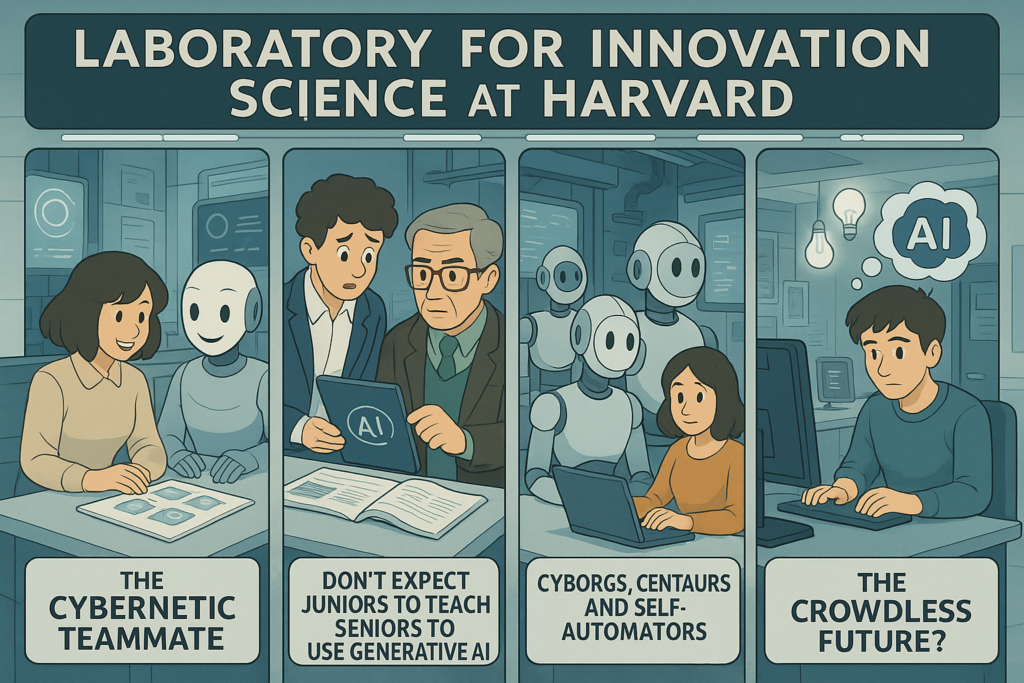
The Cybernetic Teammate: A Field Experiment on Generative AI Reshaping Teamwork and Expertise
This research marks a paradigm shift: GenAI is no longer just a productivity enhancer. It emerges as a creative collaborator—reshaping not only how we work, but how we experience work.
In this paper we argue that the focus should move beyond the binary decision of adopting or not adopting AI. Developing “AI literacy” about the capabilities and boundaries of generative tools is critical to realizing their benefits without falling into misuse.
The Crowdless Future? Generative AI and Creative Problem Solving
Future innovation systems should not replace humans with AI, but rather combine their complementary strengths: using AI to cover the middle of the idea spectrum efficiently and humans to push the boundaries of novelty.
When junior employees become de facto GenAI coaches for senior professionals, their lack of deep technical understanding can lead to misinformed practices.
Video Highlights
Karim Lakhani on the Rise of AI and the Role of Leadership!
Harvard Business School Professor on using AI to optimize your small business!
Karim Lakhani on A New Type of Firm for the Digital Age
Jackie Lane on Generative AI for Creative Problem Solving and Evaluation