Visit hbs.edu

Events

Apr 15

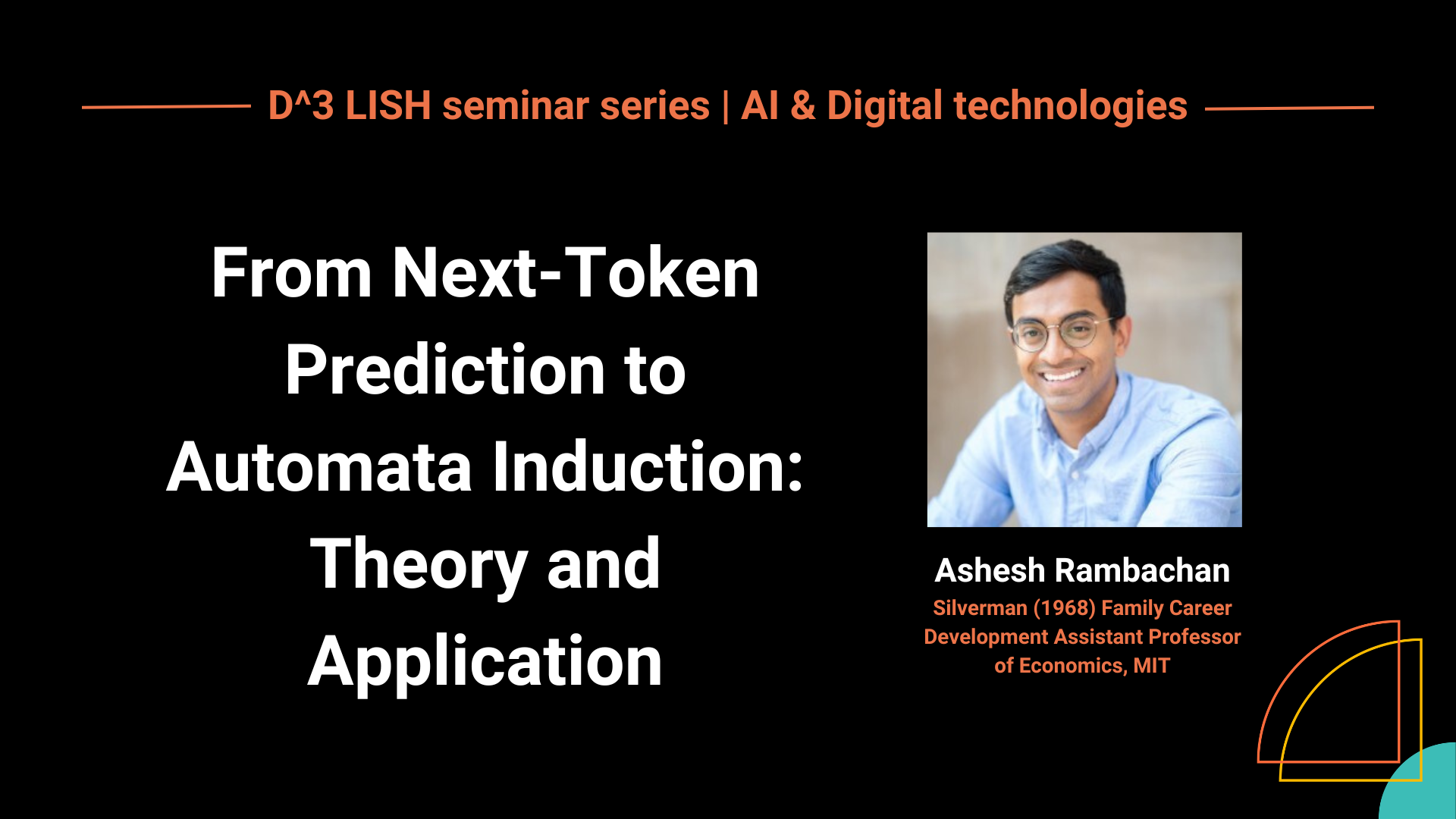
From Next-Token Prediction to Automata Induction: Theory and Application | LISH Seminar Series

1:00 pm - 2:00 pm Hybrid Event / Conference Room B82 - Baker Bloomberg Library, HBS
Karim Lakhani and Jackie Lane are hosting a new seminar series at Digital Data Design Institute at Harvard (D^3)’s LISH, spotlighting how Artificial Intelligence and Digital Technologies are transforming business and society. This is the third seminar in this series Speaker: Ashesh RambachanSilverman (1968) Family Career Development Assistant Professor of Economics, MIT Date and Time: […]
Dec 9

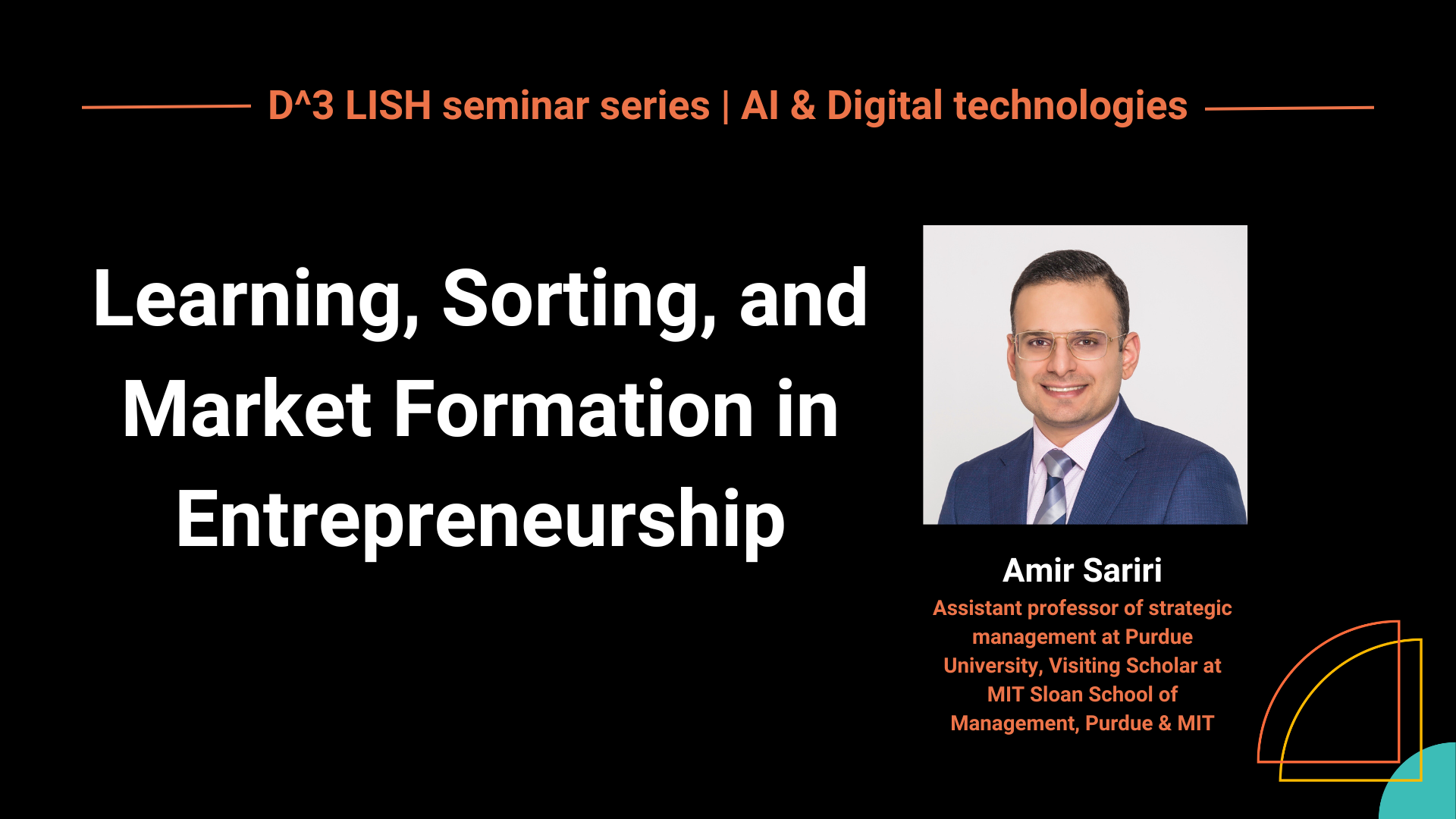
Learning, Sorting, and Market Formation in Entrepreneurship | LISH Seminar Series

1:00 pm - 2:00 pm Hybrid Event
Karim Lakhani and Jackie Lane are hosting a new seminar series at Digital Data Design Institute at Harvard (D^3)’s LISH, spotlighting how Artificial Intelligence and Digital Technologies are transforming business and society. This is the third seminar in this series Speaker: Amir SaririAssistant professor of strategic management at Purdue University, Visiting Scholar at MIT Sloan […]
Nov 18

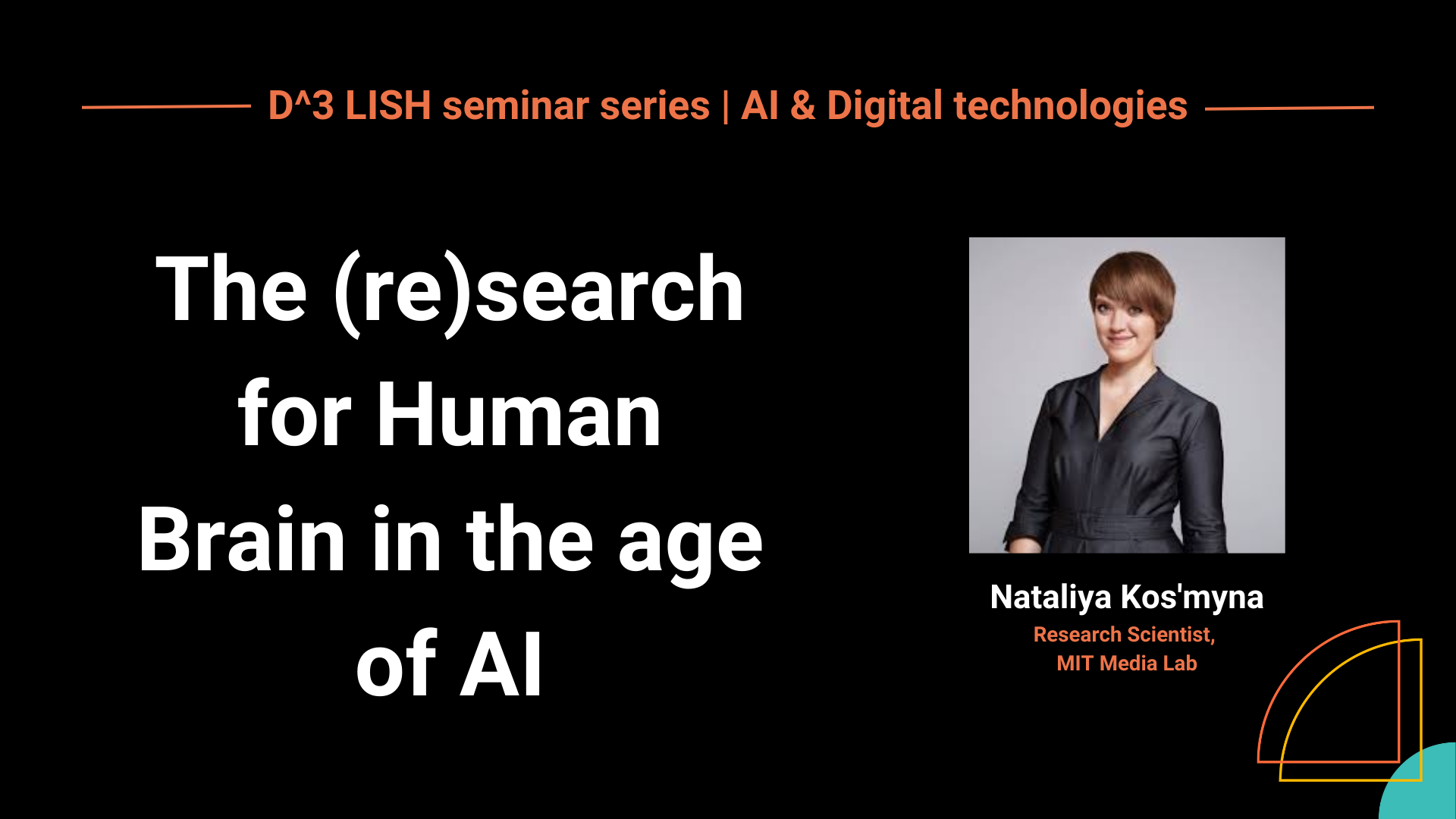
The (re)search for Human Brain in the age of AI | LISH Seminar Seminar

1:00 pm - 2:00 pm Hybrid Event
Karim Lakhani and Jackie Lane are hosting a new seminar series at Digital Data Design Institute at Harvard (D^3)’s LISH, spotlighting how Artificial Intelligence and Digital Technologies are transforming business and society. This is the second seminar in this series Speaker: Nataliya KosmynaResearch Scientist | MIT Media Lab Date and Time: November 18, 2025 | […]
Oct 29

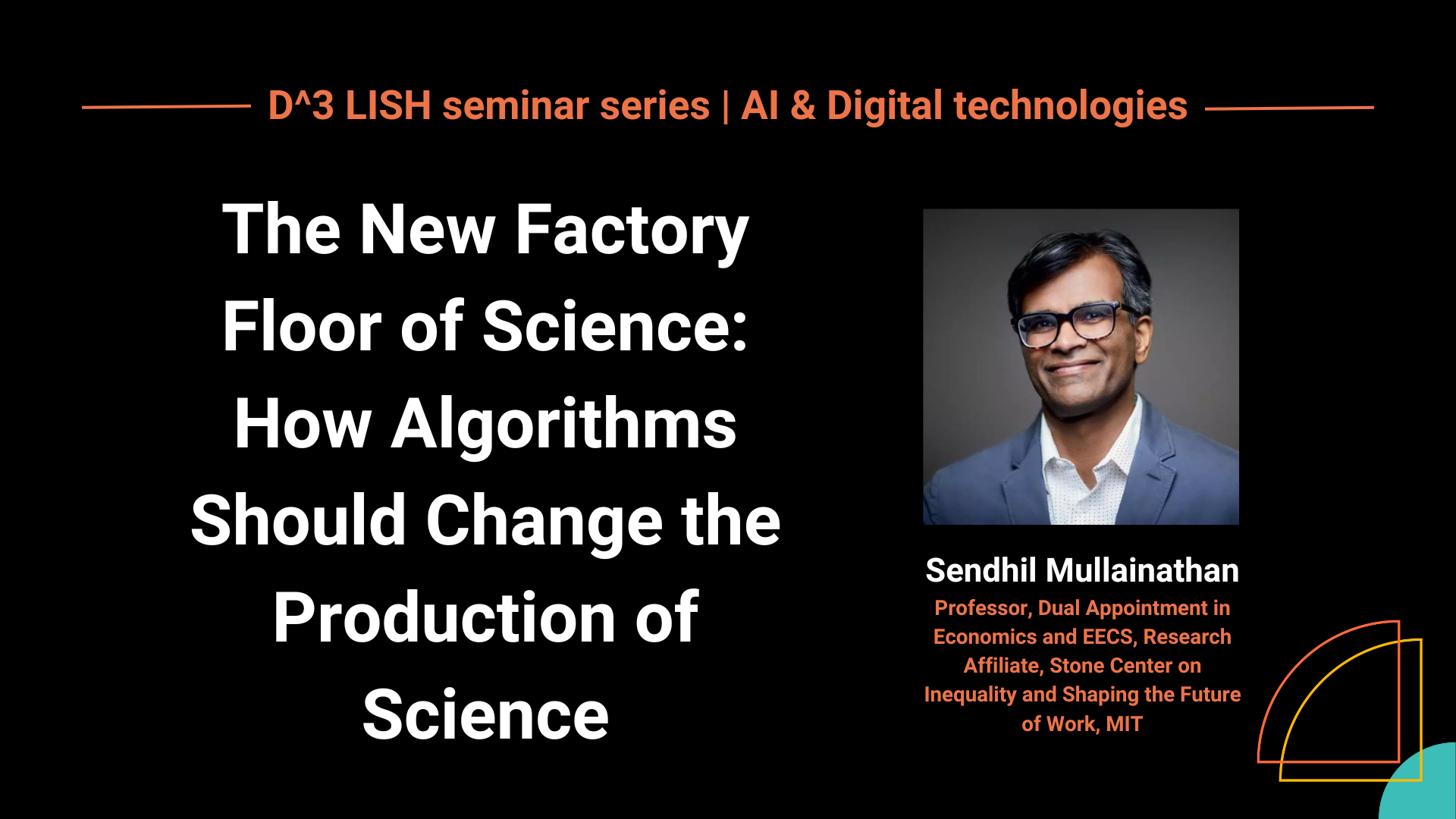
The New Factory Floor of Science: How Algorithms Should Change the Production of Science | LISH Seminar Series

1:00 pm - 2:00 pm Hybrid Event
Karim Lakhani and Jackie Lane are hosting a new seminar series at Digital Data Design Institute at Harvard (D^3)’s LISH, spotlighting how Artificial Intelligence and Digital Technologies are transforming business and society. This is the first seminar in this series Speaker: Sendhil MullainathanProfessor, Dual Appointment in Economics and EECS, Research Affiliate, Stone Center on Inequality […]
Dec 4

D^3 Digital Seminar Series

12:00 pm - 1:30 pm Hybrid Event
Firm Productivity and Learning in the Digital Economy: Evidence from Cloud Computing Date: December 4, 2024Presenter: Mert Demirer, MIT Sloan School of Management Abstract:Computing technologies have become critical inputs to production in the modern firm. However, there is little large-scale evidence on how efficiently firms use these technologies. In this paper, we study firm productivity […]
Mar 6

Does Human-algorithm Feedback Loop Lead To Error Propagation? Evidence from Zillow’s Zestimate

12:30 pm - 2:00 pm EST Hybrid Event / Cotting 107
We study how home sellers and buyers interact with Zillow's Zestimate algorithm throughout the sales cycle of residential properties, with an emphasis on the implications of such interactions. In particular, leveraging Zestimate's algorithm updates as exogenous shocks, we find evidence for a human-algorithm feedback loop: listing and selling outcomes respond significantly to Zestimate, and Zestimate is quickly updated for the focal and comparable homes after a property is listed or sold. This raises a concern that housing market disturbances may propagate and persist because of the feedback loop. However, simulation suggests that disturbances are short-lived and diminish eventually, mainly because all marginal effects across stages of the selling process---though sizable and significant---are less than one.
  • Meng Liu
Feb 7

Competition Avoidance vs Herding in Job Search: Evidence from Large-scale Field Experiments on an Online Job Board

12:30 pm - 2:00 pm EST Hybrid Event / Cotting 107
Information about the number of applicants to a job vacancy might simultaneously signal the degree of competition and vacancy quality. We study how this information affects job search. To do so, we conduct three experiments on a large online job platform in which the treatment varies what information is shown to job seekers. Information about the number of prior applicants to a vacancy increases the number of applications and redirects them to vacancies with few prior applications. Information about vacancy age increases application rates, especially to new vacancies.
  • Andrey Fradkin
Nov 15

Automation, Career Values, and Political Preferences

12:00 pm - 1:30 pm EST Hybrid Event / Cotting 107
n this paper, using a novel data set of resumes from approximately 16 million individuals from the United States, we study the career implications of automation and robotization. We calculate the lifetime career value of various occupations, combining (1) the likelihood of future transitions to other occupations, and (2) earning potential of these occupations. We document a downward trend in the growth of career values in the U.S. between 2000 and 2016. We find that while wage growth is slower, the decline in the average career value growth is mainly due to reduced upward occupational mobility. Automation and robotization are factors contributing to the decline of average local labor market career values. In commuting zones that have been more exposed to automation, the average career value has declined further between 2000 and 2016.
Nov 1

Price Controls in a Multi-Sided Market: Investigating the Effect of Commission Caps in Food Delivery Platforms

12:00 pm - 1:30 pm EDT Hybrid Event / 50 N Harvard St., Cotting House, Room 107
This paper evaluates caps on the commissions that food delivery platforms charge to restaurants. Commission caps may lead restaurants to join platforms and to post lower prices on platforms, thereby benefitting consumers. But caps may also lead platforms to raise their consumer fees, thereby reducing ordering on platforms and consequently platforms’ value to restaurants. The net welfare effects of caps are thus uncertain. To quantify these effects, I estimate a model of pricing and platform adoption in a multi-sided market using data on consumer restaurant orders, restaurants’ platform adoption, and platform fees. Counterfactual simulations imply that commission caps bolster restaurant profits at the expense of consumers and platforms.
  • Michael Sullivan
Oct 25

Introducing Keyword Recommender System (KRS): A Noble Alternative Search Recommender System in the Age of AI

12:00 pm - 1:30 pm EDT Hybrid Event / 50 N Harvard St., Cotting Hall, Room 107
In this talk, we explore the Keyword Recommender System (KRS) and consider its impact on sales volumes and market concentration. Unlike traditional, item-level recommenders, KRSs facilitate search query formation with potentially positive or negative consequences for search costs, resultant product fit, transaction volumes, and consumption diversity. We explore these effects via a randomized field experiment conducted with one of the largest mobile food-delivery platforms in Asia. The results of this experiment show that providing consumers with access to a KRS leads to a 1.2% rise in purchases over a 30-day period. Furthermore, access to a KRS leads to increased sales diversity, at both the individual and market levels.
Sep 13

Motivating High-Quality Contribution in OSS Communities: The Role of Contributors’ Private Benefits

12:00 pm - 1:30 pm EDT Hybrid Event / Cotting House, 50 N Harvard Street, Room 107
While many studies have examined contributors’ participation in open source software (OSS) communities, limited attention has been paid to the quality of their contribution. We build on von Hippel and von Krogh’s (2003) idea of private benefits and develop a model to examine how new comer contributors’ decisions regarding i) continued participation and ii) effort investment (in subsequent contribution) are affected by their beliefs about the private benefits they expect to obtain, and how the formation of such beliefs depends on their initial interactions with project gatekeepers.
  • Tony Tong
Catherine Thomas headshot
Apr 26

Who Benefits from Online Gig Economy Platforms?

12:00 pm - 1:30 pm Hybrid Event
Catherine Thomas at the London School of Economics will discuss her study on the magnitude and distribution of surplus in an online labor market for the knowledge worker gig economy.
  • Catherine Thomas

Engage With Us

Join Our Community

Ready to dive deeper with the Digital Data Design Institute at Harvard? Subscribe to our newsletter, contribute to the conversation and begin to invent the future for yourself, your business and society as a whole.