

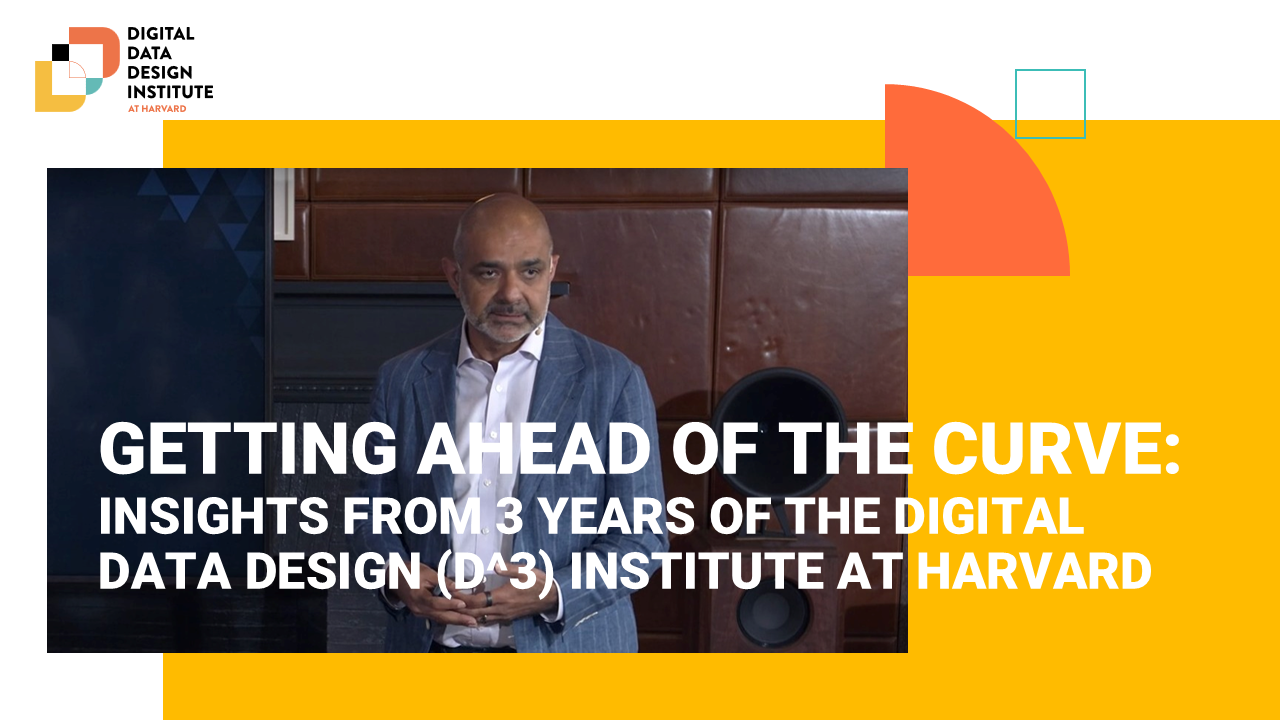
In the ever-evolving AI landscape, are you truly ready to integrate new technologies effectively, taking advantage of the radical opportunities they present for productivity increases and better operating models? Karim R. Lakhani, Dorothy and Michael Hintze Professor of Business Administration at Harvard Business School and faculty chair and co-founder of the Digital Data Design (D^3) Institute at Harvard, recently shed light on three years of the institute’s AI research findings and offered a practical toolkit for businesses and individuals in his talk AI Needs Clinical Trials: Harvard’s Findings on Democratization for TEDxBoston.
Key Insight: Falling Asleep at the Wheel
“There are some things that AI is very good at and when you use it for that function, AI performs incredibly well and people get better. But when you use AI for the task where it’s not good for, your performance drops and drops dramatically.”
Karim R. Lakhani
One of the most striking findings Professor Lakhani mentioned came from D^3’s study with Boston Consulting Group (BCG). When used for tasks within its strengths, AI can catapult average performers to the 95th percentile, meaning that expertise is no longer scarce and businesses can be filled with entire teams of top performers. However, even high performers saw their results decline when AI was applied to tasks outside of its current capabilities, a phenomenon HBS postdoctoral researcher Fabrizio Dell’Acqua calls “Falling Asleep at the Wheel.”
Key Insight: From Tool to Teammate to Boss
“What we discovered in our study was that an individual using AI is as good as a team without AI.”
Karim R. Lakhani
A D^3 study with Procter & Gamble (P&G) showed that AI can help individuals and teams to produce higher quality ideas, “democratizing” expertise by leveling the playing field. Beyond productivity gains, AI functioned as a collaborative partner, providing balance across domains and enabling those with technical expertise to incorporate a commercial perspective into their innovation efforts, and vice-versa for those with commercial expertise. What’s more, organizations in the future may use AI agents to lead teams. As Lakhani mentioned, Uber already utilizes this operating model by putting algorithms in charge of HR decisions like hiring and firing.
Key Insight: Exponential Acceleration
“While the performance capabilities of AI models is increasing exponentially […] the absorption capability of most organizations is linear.”
Karim R. Lakhani
The speed of AI advancement, compared to how most companies are adopting and integrating these tools, is creating a widening gap that smart executives will target. Unlike previous technologies such as WiFi or web browsers that organizations could evaluate slowly, AI fundamentally changes the nature of work itself, and companies that fail to keep pace may find themselves behind competitors who successfully ride the AI wave.
Key Insight: The Playbook
Learn – Do – Imagine – Act
At the end of his talk, Lakhani outlined a strategic framework for leaders navigating the AI revolution. Learning requires continuously understanding AI’s capabilities and impact, and growing your AI skillset. Doing means actually using AI tools, and in particular executives need to get their feet wet with AI rather than just delegating experimentation to their employees. Imagining involves conceiving new operating models and workflows that AI can unlock. Acting requires driving organizational change to accommodate these new ways of working.
Bonus: in a recent article for the Harvard Business Review, Lakhani and several co-authors added a fifth step to this playbook. Learn what it is here.
Why This Matters
For business leaders across industries, D^3’s research underscores that AI is reshaping business fundamentals. Understanding AI’s dual role as a democratizing force in expertise and an accelerating differentiator is crucial for future-proofing your organization. Understanding its strengths and weaknesses, fostering AI-augmented teamwork and keeping pace with AI advancement are essential for maintaining a competitive edge. Embrace AI strategically, invest in continuous learning, and be prepared to transform your organization’s approach to work.
About the Speaker

Karim R. Lakhani is the Dorothy & Michael Hintze Professor of Business Administration at Harvard Business School. He specializes in technology management, innovation, digital transformation, and artificial intelligence. He is also the Co-Founder and Faculty Chair of the Digital Data Design (D^3) Institute at Harvard and the Founder and Co-Director of the Laboratory for Innovation Science at Harvard.