
This series introduces D^3 Associates Program projects which aim to answer important questions at the intersection of artificial intelligence and digital technologies in business and society.
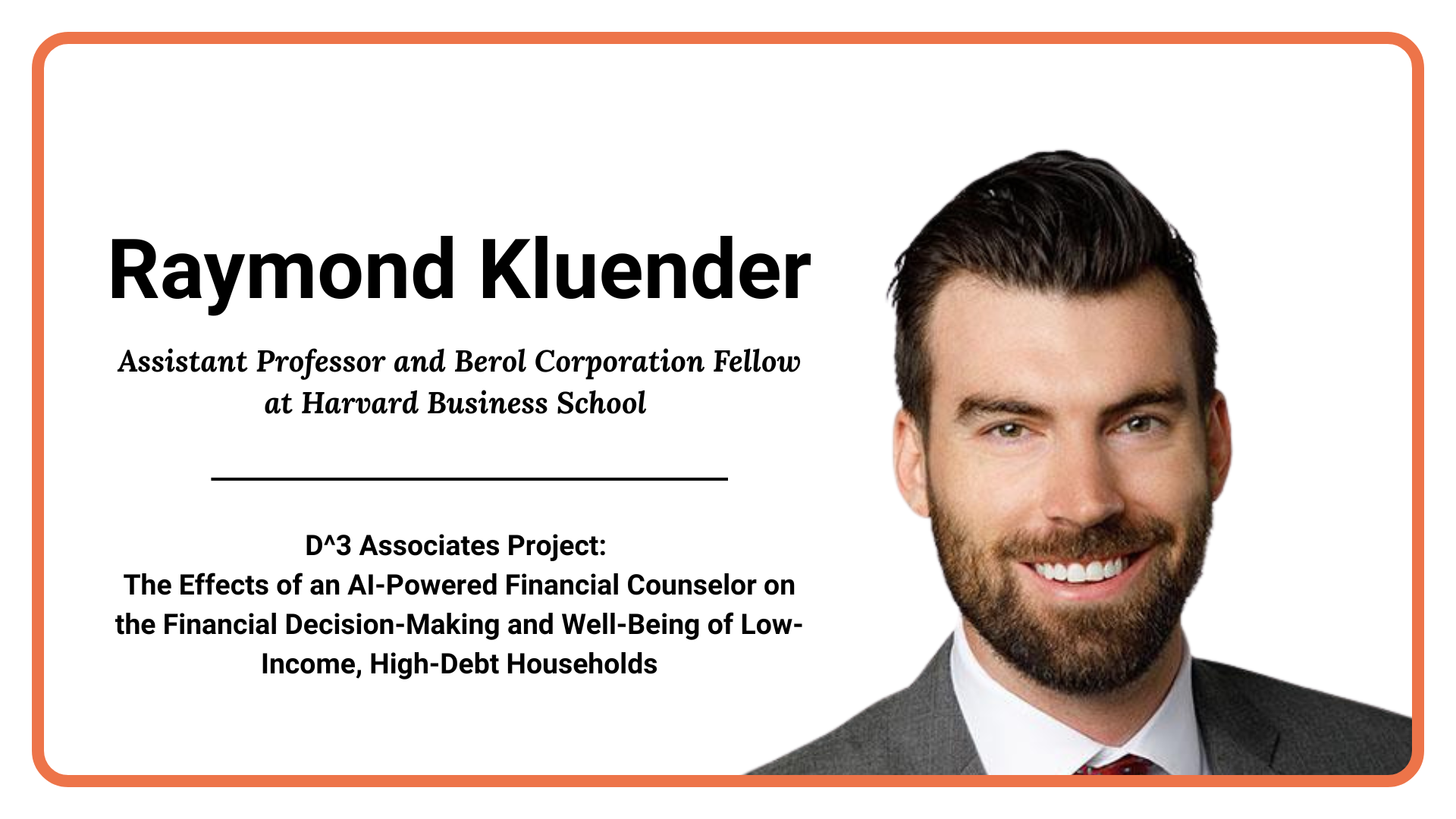
This article shares insights from Raymond Kluender, Assistant Professor and Berol Corporation Fellow at Harvard Business School who is pursing research on the topics of artificial intelligence and finance.
1.What drew you to this area of research and how did you first become involved in this work?
My research agenda primarily focuses on how technology can help solve social problems. I’ve long been interested in bankruptcy as a form of social insurance policy. The United States generally has a reputation of having an incomplete social safety net, but our bankruptcy law is actually the most generous in the world. Understanding who decides to file for bankruptcy and how they are affected has long been a question that has interested me.
2.What are some common misconceptions or barriers around the problem you’re working to solve?
Bankruptcy is widely misunderstood. It’s often framed as the worst possible financial outcome, when in reality, it’s a legal mechanism that allows individuals to discharge overwhelming debt and get a fresh start. From a purely economic standpoint, bankruptcy is actually underutilized. People who file for bankruptcy often find themselves in a better financial position afterward. For example, data shows that bankruptcy filers typically see their credit scores increase by about 80 points in the year following their filing. This data underscores a major misconception: bankruptcy isn’t a failure; it’s a strategic tool that can provide significant relief and a pathway to financial stability.
3.What research is being done on this topic and how is your approach or perspective unique?
One of the major barriers to filing for bankruptcy is the cost and the lack of information about its benefits. Many individuals who could benefit from bankruptcy are deterred because they can’t afford to pay a lawyer or the filing fee. My research, in collaboration with Upsolve, a 501(c)(3) nonprofit, aims to leverage technology to tackle these problems. By creating a platform that acts like a ‘TurboTax for bankruptcy,’ we can help debtors file their paperwork more easily. Additionally, new AI-enabled tools can assist in answering debtors’ questions and guiding them toward the right financial solutions.
4.What excites you most about this work and its potential impact?
I’m excited about the potential of using technology to reach underserved populations. This work has the potential to democratize access to financial relief tools, making it easier for those who need them most to find a path forward. The idea that we can leverage digital solutions to break down longstanding barriers is incredibly motivating.
5.How do you hope working with D^3 will amplify the impact of your work?
D^3 embodies so much of what I love about working at Harvard Business School. It’s at the absolute frontier of research while also being deeply enmeshed with practice. By working with D^3, I hope to amplify the impact of my work by leveraging their network and resources to bring our findings into real-world applications. This kind of collaboration ensures that our research doesn’t just stay in academic journals but translates into tangible benefits for people who need it most.
6.What changes do you hope to see in your field as a result of the work being done in this area?
I hope to see a shift in the field toward a more holistic understanding of financial distress and the solutions available. I’d like to see more integration of technology and behavioral insights into policy design, reducing the stigma and complexity surrounding bankruptcy. Ultimately, I want to see a system where people feel empowered to use these tools without fear or confusion, leading to better financial health outcomes across the board.
7.What’s an essential area in which AI and digital technologies will reshape the way businesses or society operate in the long run that we may not be considering?
I’m particularly interested in how AI and digital technologies will interact with entrenched legacy systems, especially in the realm of government provision of social insurance. One area that’s often overlooked is the modernization of the courts and legal processes. By integrating AI into these systems, we could dramatically streamline and simplify processes, making legal and social services more accessible and efficient. This could transform how society navigates and benefits from longstanding institutions.
The D^3 Associates Program supports and accelerates faculty research into the ways AI and digital technologies are reshaping companies, organizations, society, and practice.