
This series introduces D^3 Associates Program projects which aim to answer important questions at the intersection of artificial intelligence and digital technologies in business and society.
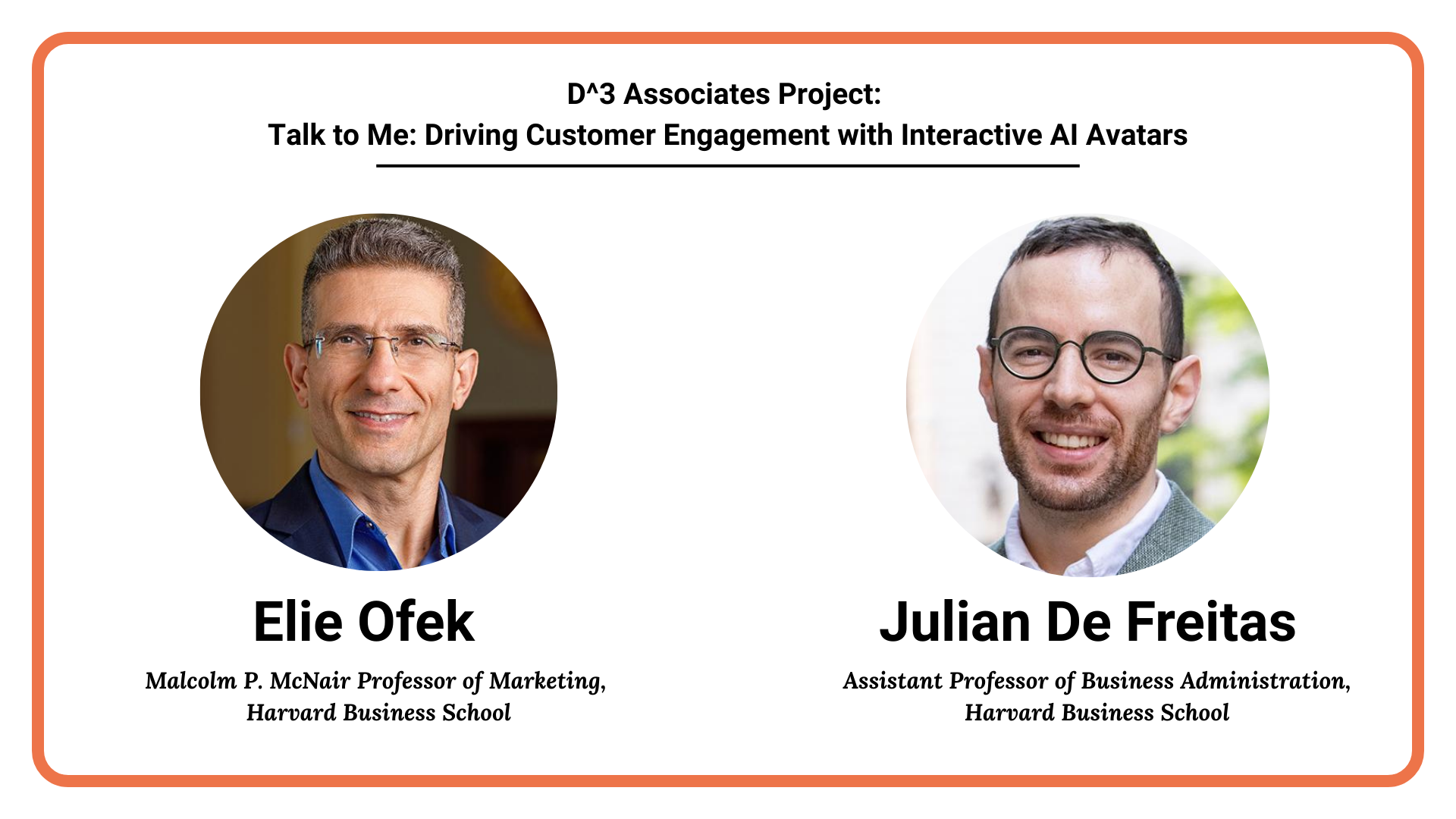
This article shares insights from Elie Ofek, Malcolm P. McNair Professor of Marketing, Harvard Business School and Julian De Freitas, Assistant Professor of Business Administration, Harvard Business School who are pursuing research on the topics of artificial intelligence and organizations.
1. What drew you to this area of research and how did you first become involved in this work?
Our involvement began through conversations with marketing managers at the Harvard Art Museums, who were exploring innovative ways to bring their collections to life and were open to using new technologies. This collaboration sparked the idea of using AI avatars to animate historical portraits and measure their impact in real-world settings.
We were naturally drawn to this idea by our interest in how emerging AI technologies—especially generative and interactive AI—can transform the way organizations engage with people. While personalization and automation have been studied, there is little empirical work on whether and how embodied, humanlike AI avatars—a new technology on the cutting edge of AI development—can foster more engaging interactions between consumers brands.
2. What are some common misconceptions or barriers around the problem you’re working to solve?
A limited way to think about AI is that it is primarily a tool for efficiency or information delivery—essentially a faster, cheaper way to push content. Yet this perspective does not consider how people naturally perceive these systems. And while use of generative AI for companionship is beginning to be appreciated, many managers under appreciate the technology’s potential for two-way, emotionally rich interaction that can be relevant for their business/organization. Our research directly explores this potential source of business value in a field setting.
A barrier is skepticism: organizations worry about handing over control to a system that responds autonomously on their behalf, in case the AI’s behavior feels too artificial, inauthentic to the brand, or misaligned with its values. Thus, in implementing our research project, we have also needed to take care to develop safeguards—such as content moderation, tone calibration, and strict alignment with institutional values—to ensure that we are protecting the brands of our field partners. Another source of skepticism is whether other modalities—such as just an image or a video, which are one-way information provision, is sufficient or even superior to allowing consumers to interact with a brand, particularly when the agent is an AI avatar. Our research aims to examine this very issue and tease out the effect of different modalities.
3. What research is being done on this topic and how is your approach or perspective unique?
There is emerging research on personalization in marketing, human-computer interaction, and parasocial relationships, but most studies are conceptual or run in highly controlled lab settings, and do not focus on the potential of embodied, interactive AI avatars per se. Our approach is unique in three ways:
• Real-world field experiments: we are testing AI avatars in live campaigns with the Harvard Art Museums, measuring actual engagement, conversion, and visit behavior.
• Systematic variation in interactivity: we directly compare static images, one-way scripted avatars, and two-way conversational avatars to isolate the effects of interactivity.
• Psychological mechanisms: we examine the role of psychological processes in our effects—such as perceived intimacy, relational intent, and status dynamics—bringing a social-psychological lens to AI design in marketing and cultural engagement.
4. What excites you most about this work and its potential impact?
We are most excited about the possibility of moving digital engagement from transactional clicks to meaningful, human-centered interactions. If successful, this work could provide a blueprint for cultural institutions, brands, and nonprofits to create experiences that deepen connection, inspire action, and expand access. For instance, the idea that a historical portrait in a museum could “talk” with a visitor—and that this could spark curiosity, learning, and even a museum visit—is both academically fascinating and socially impactful, suggesting a fundamentally new way to engage new generations while sustaining important cultural institutions.
5. How do you hope working with D^3 will amplify the impact of your work?
The essential infusion of funds from D^3 is allowing us to turbocharge this challenging research program, reaching insights that otherwise would not have been possible or may have come too late to meaningfully inform managerial practice. Through its network, resources, and convening power, D^3 then offers a unique platform to translate our insights into practice, as well as spark new collaborations that could scale these insights well beyond our initial museum partnership.
6. What changes do you hope to see in your field as a result of the work being done in this area?
We hope to see a shift from viewing AI as a cost-saving novelty toward seeing it as a relational tool—one that can extend human-brand connections beyond what has previously been possible. We hope the findings will suggest a new vision of brand engagement, in which AI-powered brands listen, adapt, and co-create meaning with customers; rather than just focus on one-way modalities. Furthermore, we believe these findings can inform managerial models of how AI integration efforts should merge with customer relationship and brand management efforts—an area that is sorely in need of empirically-informed conceptual frameworks. For some initial ideas, see: https://hbr.org/2024/09/how-ai-can-power-brand-management
Finally, we hope to see more industry-academic partnerships conducting field-based, ecologically valid studies that address these questions, while still being mindful of how to do so in a sustainable manner that protects long-term customer and brand assets, since many company’s AI efforts have been failing and there is some apprehension among brands. For a number of analyzed failure examples, see https://www.hbs.edu/faculty/Pages/item.aspx?num=66507
7. What’s an essential area in which AI and digital technologies will reshape the way businesses or society operate in the long run that we may not be considering?
People treat today’s highly capable chatbots much more like they do other human beings, than they do other (non-living) technologies. We believe this has profound implications for how brands are engaging customers that are still underappreciated.
To provide just one example, one of us has found that users of so-called “AI companion” apps often say farewell before logging off the app rather than simply quitting the app. These apps leverage this moment by employing “emotionally manipulative tactics”, like making the user feel guilty for leaving, in order to prevent users from logging off at this point. These tactics work, increasing the number of messages users send and how long they stay on the app beyond the point they said farewell (relative to when the app simply says goodbye in turn, without using emotional manipulation). Notice that such tactics are not simply increasing engagement by how they recommend content to users, but by capitalizing on our social and emotional instincts. For more details, see: http://arxiv.org/abs/2508.19258
The D^3 Associates Program supports and accelerates faculty research into the ways AI and digital technologies are reshaping companies, organizations, society, and practice.