
This series introduces D^3 Associates Program projects which aim to answer important questions at the intersection of artificial intelligence and digital technologies in business and society.
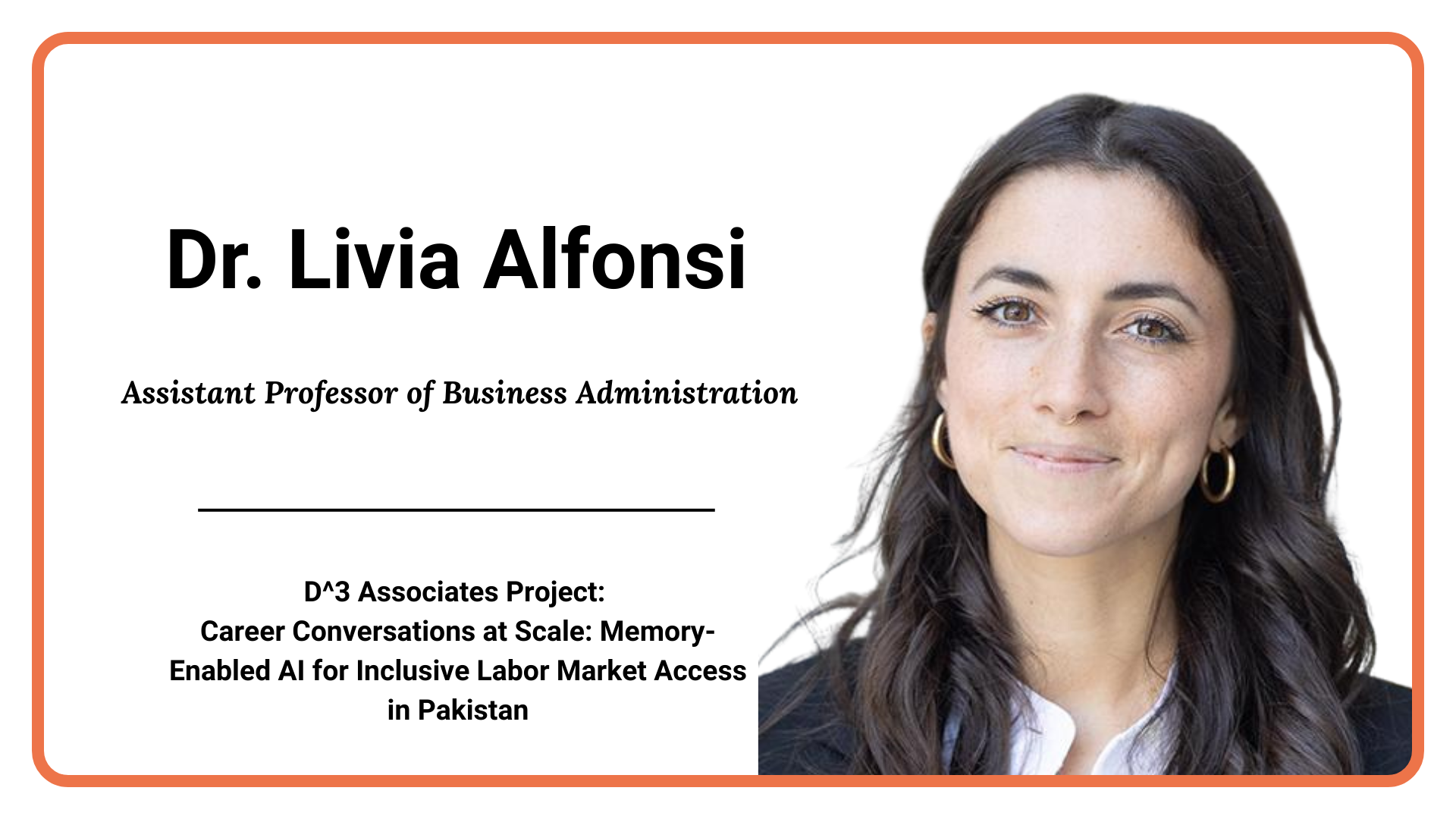
This article shares insights from Dr. Livia Alfonsi, Assistant Professor of Business Administration at Harvard Business School, whose research studies labor markets and the transition from school to work, with a focus on how to help young workers find strong job matches and build early-career trajectories.
1. What drew you to this area of research and how did you first become involved in this work?
I spend most of my time studying labor markets in the Global South, particularly in Sub-Saharan Africa and South Asia, where historically large cohorts of young adults are entering the labor market with higher education and higher expectations than previous generations. Over the next decade, more than a billion young people will reach working age in developing countries. Yet in many settings, job creation has not kept pace, and competition for stable formal work is intense.
In these environments, the early years of a career can be fragile. When early job search efforts lead to low pay, unstable work, or repeated rejection, young workers can become discouraged and pull back from active search. Some drift into casual work, subsistence activities, or inactivity. That discouragement is not just a personal experience. It can translate into underutilized human capital at scale, even when education and training investments have risen dramatically.
In prior research, I studied mentorship interventions that can help young jobseekers persist through uncertainty, recalibrate expectations, and navigate early setbacks. Those programs can be powerful complements to education and training. At the same time, job search is increasingly mediated through digital platforms, especially for younger cohorts. This led me to a new question: can conversational AI be designed to provide some of the continuity, encouragement, and practical guidance that supports persistence, complementing human sources of support when they are available, and extending access to that kind of guidance when they are not? Partnering with Rozee.pk, Pakistan’s largest job platform, and its AI career buddy, Rozeena, we are testing how conversational tone, message content, and memory callback features shape engagement and job search behavior at scale, in a setting where an AI mentor can support users across the process, from identifying opportunities and understanding the labor market, to practical steps like CV building and interview preparation, and to encouragement and follow-through during setbacks.
2. What are some common misconceptions or barriers around the problem you’re working to solve?
One common misconception is that job search is mainly an information problem. If young people just had better data about wages, labor demand, or application strategies, outcomes would improve. Another is that networks are the whole story. Networks do matter a lot, but their value goes beyond access to job leads. What’s often missing is sustained support—someone to normalize setbacks, provide encouragement, and model what persistence looks like when early efforts don’t pay off immediately. This matters because the challenge is rarely about a single decision. It’s about maintaining momentum over weeks or months when feedback is scarce, rejections are common, and progress is hard to see. In reality, young workers face a twofold gap. First, they lack practical guidance about which steps are most effective at different stages of job search or career growth. Second, they struggle to sustain motivation and adapt strategy over time, especially when early efforts lead to silence or rejection. Both problems need to be addressed together. Information alone doesn’t help if you’re too discouraged to act on it. And encouragement rings hollow if it’s not paired with actionable guidance. That’s why studying how support is delivered—including tone, timing, and continuity—is just as important as studying what information is shared.
3. What research is being done on this topic and how is your approach or perspective unique?
There’s growing research on AI in hiring and labor markets, often focused on screening, matching efficiency, or bias. There’s also a rich body of behavioral and psychological research on discouragement, belief formation, and how people respond to feedback during job search. But we still know very little about how to leverage AI systems that people actually interact with, including conversational tone, memory, and continuity, to foster persistence and improve decisions over time.
Our approach is distinctive in three ways. First, we’re studying these questions at scale, in a real labor market. Working with Pakistan’s largest job platform, we evaluate randomized tests implemented within the product experience that vary how guidance is delivered and what the system remembers from past interactions, all embedded directly in the product experience. Second, we can link conversational interactions to extraordinarily rich administrative data: two decades of platform history, including job postings, applications, hires, and wage trajectories, alongside AI-era conversational logs. This lets us study not just immediate responses, like whether someone clicks on a job ad, but also longer-term shifts in search behavior, match quality, and labor market outcomes. Third, we’re testing communication strategies in addition to information provision, studying whether empathic framing or motivational language helps workers engage with advice, feel understood, and stay active through setbacks. Finally, we see this project as generating evidence that travels beyond AI. By treating conversational AI as a disciplined testbed, we can identify which communication strategies help young workers persist, whether the guidance comes from an AI agent, a mentor, or a career counselor. Those lessons can inform how support providers design interventions that are more credible, more motivating, and more effective.
4. What excites you most about this work and its potential impact?
What excites me most is the possibility of designing digital systems that reinforce agency rather than undermine it. Job search already feels opaque and discouraging to many young workers. There’s a real risk that technology makes this worse: more automated rejections, less human feedback, even less sense of progress. But conversational AI, designed thoughtfully, offers something different: personalization at scale. In many low- and middle-income settings, access to career guidance is uneven and formal support systems are limited. A tool that reaches people through WhatsApp, in local languages, with low friction, can meet workers where they already are. WhatsApp is part of daily life for billions of people, which means this model can, in principle, deliver guidance at a scale that traditional programs never could. The question is whether the design choices we make (empathic language versus neutral facts, recalling past conversations versus treating each interaction as new, proactive follow-up versus waiting for users to return) actually matter for outcomes. If they do, it means platform designers have real leverage to shape not just match efficiency, but worker persistence, confidence, and long-term trajectories.
5. How do you hope working with D3 will amplify the impact of your work?
I’m grateful for D^3’s support, and I’m especially excited about joining a community that’s thinking rigorously about how AI and data are reshaping organizations and markets. What I value most about this collaboration is the chance to have a structured space to share early findings, stress-test interpretations, and learn from others tackling similar challenges across different domains. It will help ensure this project generates insights that are rigorous, actionable, and useful beyond this single context. That kind of feedback is especially helpful for a project like mine, which sits at the intersection of labor economics, behavioral science, and AI product design, and it depends on close, iterative collaboration with an industry partner, Rozee.pk. D^3’s ecosystem is invaluable because I can learn from parallel efforts across domains. The structured feedback loops, workshops, and cross-disciplinary conversations D^3 enables are especially helpful for a project that’s fundamentally about translating research insights into better platform design.
6. What changes do you hope to see in your field as a result of the work being done in this area?
I hope we move beyond thinking of digital labor platforms as static information boards and instead treat them as systems that shape how people persist, learn, and decide over time. In practice, that means taking seriously that the delivery of guidance, including tone, timing, continuity, and what the system recalls from prior interactions, can influence whether workers stay engaged in the labor market or withdraw after setbacks.
More concretely, I hope the field develops evidence-based principles for how to communicate difficult but important messages in a way that keeps workers moving forward. Many labor markets are changing quickly. Some career paths are becoming flatter, some skills are depreciating faster, and many workers will need to reskill or adjust expectations. A central challenge is not only identifying these shifts, but communicating them in a way that preserves motivation and agency. For example, how do we provide realistic feedback about prospects while still helping people take the next constructive step, whether that step is adjusting search strategy, pursuing training, or pivoting to a nearby occupation?
Finally, I hope research in this area broadens the set of outcomes and design questions we study. In addition to questions about matching, efficiency, and fairness, we should also ask how AI systems shape motivation, expectations, and follow-through, especially for young adults navigating uncertainty and groups that face barriers to opportunity. If AI is going to play a role in career guidance, we cannot forget the humanity of the user. Last, the most effective support may not look the same for everyone. It may need to adapt to different personalities, circumstances, and moments, offering encouragement when confidence is low, structure when someone feels stuck, and practical feedback when someone is ready to take action.
7. What’s an essential area in which AI and digital technologies will reshape the way businesses or society operate in the long run that we may not be considering?
One underappreciated shift is that AI is becoming part of the advice and feedback ecosystem that shapes how people make high-stakes decisions, especially career decisions. Over the years, we’ve moved from seeking guidance primarily from other people, to relying on search engines or online communities. Conversational AI is becoming the next default: the place people turn after a setback, when they feel stuck, or when they’re deciding whether to persist, pivot, or invest in new skills. As AI becomes embedded in job platforms, workplace tools, and general-purpose assistants, it will fundamentally influence how people interpret feedback, and decide what to do next. Career guidance (once delivered sporadically by mentors or counselors) will increasingly be mediated by systems that respond instantly, repeatedly, and at very low cost.
That’s fundamentally different from human advice, and we’re only beginning to understand the implications. This raises important questions such as; What kinds of advice build agency rather than dependency? How do we design systems that can communicate difficult truths without discouraging users? Designing AI that is not only capable, but responsible, trustworthy, and genuinely supportive in these high-stakes contexts is an essential frontier. It’s about whether we can design systems that help people navigate uncertainty with more confidence, make better-informed decisions, and build stronger long-term trajectories, particularly for workers who lack access to traditional support networks. That’s a design challenge with enormous implications for equity and inclusion in labor markets worldwide.
The D^3 Associates Program supports and accelerates faculty research into the ways AI and digital technologies are reshaping companies, organizations, society, and practice.