
This series introduces D^3 Associates Program projects which aim to answer important questions at the intersection of artificial intelligence and digital technologies in business and society.
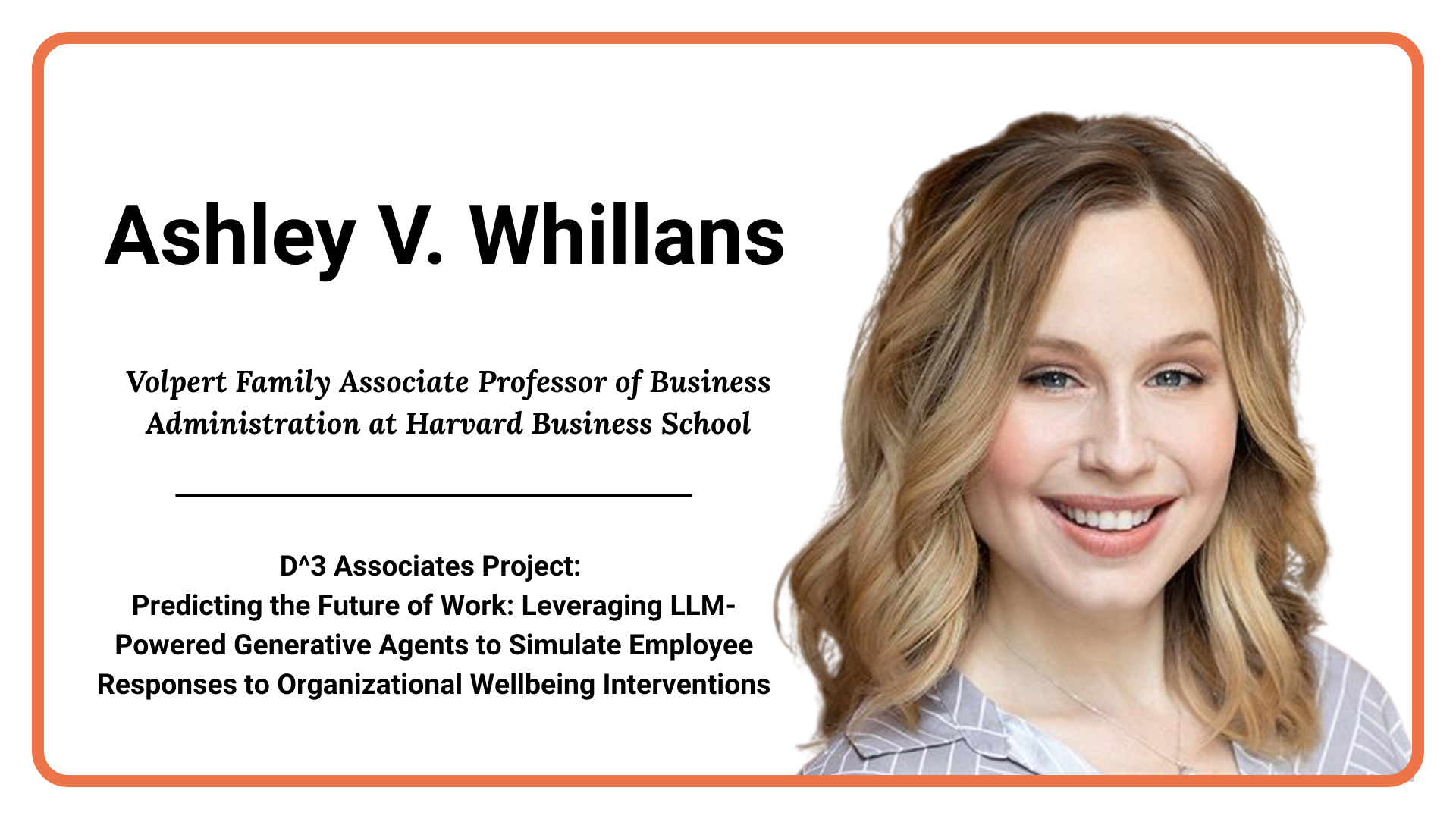
This article shares insights from Ashley V. Whillans, Volpert Family Associate Professor of Business Administration at Harvard Business School who is pursuing research on the topics of artificial intelligence and organizations.
1. What drew you to this area of research and how did you first become involved in this work?
I’ve spent years studying workplace stress and well-being, watching organizations pour money into wellness programs with little to show for it. By 2026, global corporate spending on wellness will top $94.6 billion, yet stress levels continue to rise–45% of employees report feeling stressed “frequently” or “all the time.” The disconnect is staggering—companies are spending more than ever but achieving less. What struck me was how poorly we understand the variability of employee responses to well-being initiatives. Some employees thrive with certain interventions while others see no benefit, or worse, feel more stressed. I have found that high-stress employees cost organizations an additional $5.3 million annually per 1,000 employees, yet most wellness programs completely miss these workers. This insight led my postdoctoral fellow Dr. Sumer Vaid and I to explore how we might leverage AI to predict these differential responses before implementation. We realized that generative AI agents could simulate everyday employee behavior by using the intensive longitudinal data we have been collecting for years—data that captures employees’ everyday patterns of thinking, feeling, and behaving.
2. What are some common misconceptions or barriers around the problem you’re working to solve?
One misconception is that employee well-being requires a one-size-fits-all solution. Leaders often believe that if they implement the “right” wellness program, it will work for everyone. But our data suggests that high-stress employees—who make up to 45% of the workforce in our recent analysis—respond very differently to interventions than their low-stress peers.
Another misconception is that we need to choose between speed and accuracy when implementing workplace changes. Many companies run costly pilots that take months or make decisions based on gut instinct. Many leaders are understandably cautious about AI’s ability to accurately predict human behavior, especially as related to something as complex as workplace well-being because they have seen too many tech solutions overpromise and underdeliver. That is why we are focusing on rigorous validation against real-world data, to demonstrate that these simulations can genuinely help organizations make better people management decisions.
3. What research is being done on this topic and how is your approach or perspective unique?
While other researchers and practitioners in this space are using AI to analyze workplace data or provide chatbot therapy, we’re doing something different: We are creating dynamic digital twins of employees to predict their behavioral and psychological responses to organizational changes. Traditional agent-based modeling in management science has historically relied on simplified rules that fail to capture and simulate how employees’ patterns of thinking, feeling and behaving evolve over time. Our approach integrates intensive longitudinal psychological data (that we have collected through our research) with objective behavioral monitoring data (obtained through proprietary datasets that we obtained from employee monitoring tools) to create dynamic generative agents that exhibit realistic fluctuations in stress, engagement, and productivity. Unlike the vast majority of existing work on generative agents, we are not just tracking static demographics; we are modeling the temporal dynamics of workplace psychology. This means we can simulate not just whether a well-being intervention might work, but why it works for some employees (vs others), how its effectiveness varies over time, and any impact a psychological intervention might have on related workplace outcomes such as productivity.
4. What excites you most about this work and its potential impact?
What gets me up in the morning is the possibility of ending a trial-and-error cycle that costs organizations millions and exhausts employees and managers alike. Imagine if leaders could test ten different versions of a well-being intervention virtually, see exactly which employees would benefit the most from it, and implement only the most promising approach, or even better, customize the design of the intervention for each segment separately. The possibility of this AI-led dynamic approach has the potential to reduce the $5.3 million annual cost per 1,000 employees that stress creates while improving worker productivity. Beyond the numbers, I’m excited about democratizing access to sophisticated predictive capabilities—smaller organizations could use these predictive tools to make evidence-based decisions that previously required massive research budgets to design pilot programs, implement, and test at scale.
5. How do you hope working with D^3 will amplify the impact of your work?
D^3’s support comes at a crucial moment when we need to move from proof-of-concept to real-world validation. The funding allows us to work with three industry partners, creating a feedback loop between academic rigor and practical application. Being part of D^3’s network also facilitates critical connections with researchers tackling AI challenges across completely different domains. These cross-pollination opportunities are invaluable. In our case, someone working on AI in finance might have insights about risk prediction that transform how we model the longitudinal employee stress response. D^3’s emphasis on translating research into practitioner tools aligns with our goal of making this research accessible beyond academia.
6. What changes do you hope to see in your field as a result of the work being done in this area?
I envision a future where no organization implements a major employee initiative without running simulations to understand differential impact first. This change would shift how we think about workplace interventions—from hoping they work to knowing how they’ll work and for whom. We need to move beyond the current approach where 85% of companies offer wellness programs but stress levels continue to rise. Our field must embrace the complexity of human behavior at work rather than defaulting to simplistic solutions. If we succeed, the standard practice to implement any employee initiative that affects workers lives will be to test these interventions virtually first, just as engineers simulate building performance before construction.
7. What’s an essential area in which AI and digital technologies will reshape the way businesses or society operate in the long run that we may not be considering?
Stress, burnout, disengagement, distrust, and disillusionment can spread through organizations like wildfire, but we’ve never been able to model these dynamics accurately. With AI simulations, we can predict not only individual responses, but how one person’s improved well-being or trust might cascade through their team, or conversely, how a stressed manager might impact an entire department’s productivity. This network modeling could reshape how we think about organizational health—moving from treating individual “symptoms” to understanding and simultaneously managing the entire organizational ecosystem. The implications of this predictive approach extend beyond well-being to the design of teams, offices, and org charts.
With AI simulations, we can intentionally and efficiently architect the future of work. The organizations that master this predictive capability won’t just manage workplace stress better—they’ll build resilient cultures that more adeptly turn human potential into competitive advantage.
The D^3 Associates Program supports and accelerates faculty research into the ways AI and digital technologies are reshaping companies, organizations, society, and practice.