
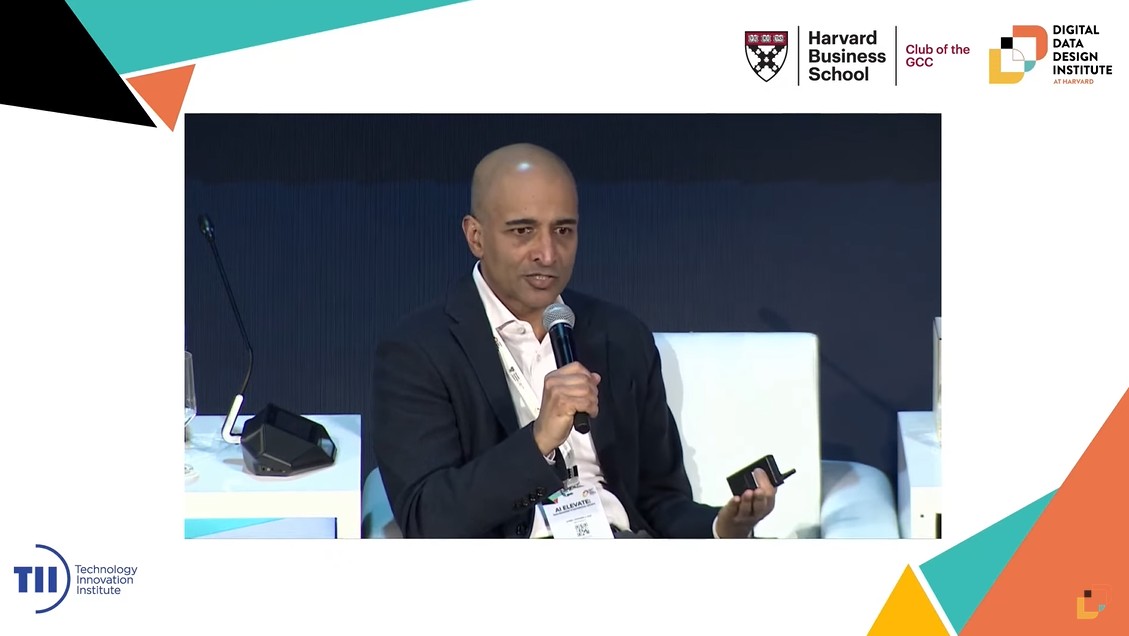
As AI continues to reshape industries globally, the Digital Data Design (D^3) Institute at Harvard and the Harvard Business School Club of the Gulf Cooperation Council hosted AI Elevate: From Readiness to Exponential Growth on December 13, 2024, in Dubai, UAE. This one-day conference provided business leaders, researchers, and government officials with crucial insights into AI strategy, industry transformation, and global market integration. For an introduction to the day-long conference, see the Opening Remarks and the Agenda.
For the session Strategy and the Declining Cost of Expertise, Bobby Yerramilli-Rao, Chief Strategy Officer at Microsoft, and D^3 co-founder Karim Lakhani discussed the far-reaching implications of AI on business operations, organizational structures, and strategic planning. Their insights and research offer a compelling vision of how companies must adapt to thrive in an era of proliferating access to expertise.
Key Insight: Expertise is No Longer Scarce, it’s Scalable
“[T]hose that were behind the average, those that were below average, all of a sudden now can be at the average, and if the average of the AI is better than the humans, then they’ll be at wherever the average of the AI is at.”
Karim Lakhani
The most immediate impact of AI is appearing in productivity and performance, with gains that defy traditional economic expectations. AI is effectively raising the floor of competency on difficult tasks that once required years of specialized training across a wide range of fields. Expertise, which used to be a key driver of competitive advantage, is now democratized, and the implications are seismic.
Key Insight: You are More Than an Individual
“[O]ver time, each person can manage a raft of agents, AI agents, to do things for them, so now every person is effectively a team.”
Bobby Yerramilli-Rao
Yerramilli-Rao and Lakhani discussed a future where employees regularly incorporate their own AI agents into their work, and even bring them along across jobs and educational experiences. According to Yerramilli-Rao and Lakhani, companies will need to integrate these AI agents into their systems while maintaining control, governance, and security. For hiring purposes they will need to identify individuals who can effectively collaborate with human-AI teams. The outcome will be flatter structures and less-siloed employees compared to traditional departmental architecture. One vivid example the speakers gave was Focus Fuel, a startup launched by three friends working part-time using GPT tools to develop, market, and scale a new consumer product, all without prior Consumer Packaged Goods (CPG) experience.
Key Insight: Know Your Core Value Proposition
“I think the imperative here is that everyone has to get very very clear about what it is that they’re doing to add value and then use AI to enhance that capability.”
Bobby Yerramilli-Rao
The competitive landscape may be entering a phase of continuous acceleration where companies must simultaneously leverage AI while preparing for advances in AI to match and then exceed their current capabilities. If AI levels the playing field, companies must clarify what truly sets them apart. What are you uniquely good at, and what expertise is replicable by AI or your competitors using AI?
Why This Matters
For business leaders, these insights signal the beginning of a new era where strategic value comes from focus, speed, and broad AI implementation. Those who treat this as a technology upgrade rather than a fundamental shift risk being outpaced. The question is no longer whether AI will transform your industry, but whether your organization will lead or scramble to catch up. Embracing these changes and proactively reshaping your organization around AI capabilities may be the key to unlocking previously unheard of levels of innovation, efficiency, and success in the years to come.
Read their article Strategy in an Era of Abundant Expertise here.
Meet the Speakers

Bobby Yerramilli-Rao is Chief Strategy Officer at Microsoft. He has co-founded several companies, and has served at organizations including Vodafone and McKinsey. He holds an MA from the University of Cambridge and a PhD from the University of Oxford.

Karim R. Lakhani is the Dorothy & Michael Hintze Professor of Business Administration at Harvard Business School. He specializes in technology management, innovation, digital transformation, and artificial intelligence. He is the Co-Founder and Chair of the Digital Data and Design (D^3) Institute at Harvard and the Founder and Co-Director of the Laboratory for Innovation Science at Harvard.