
Karim Lakhani and Jackie Lane are hosting a new seminar series at Digital Data Design Institute at Harvard (D^3)’s LISH, spotlighting how Artificial Intelligence and Digital Technologies are transforming business and society. This is the third seminar in this series
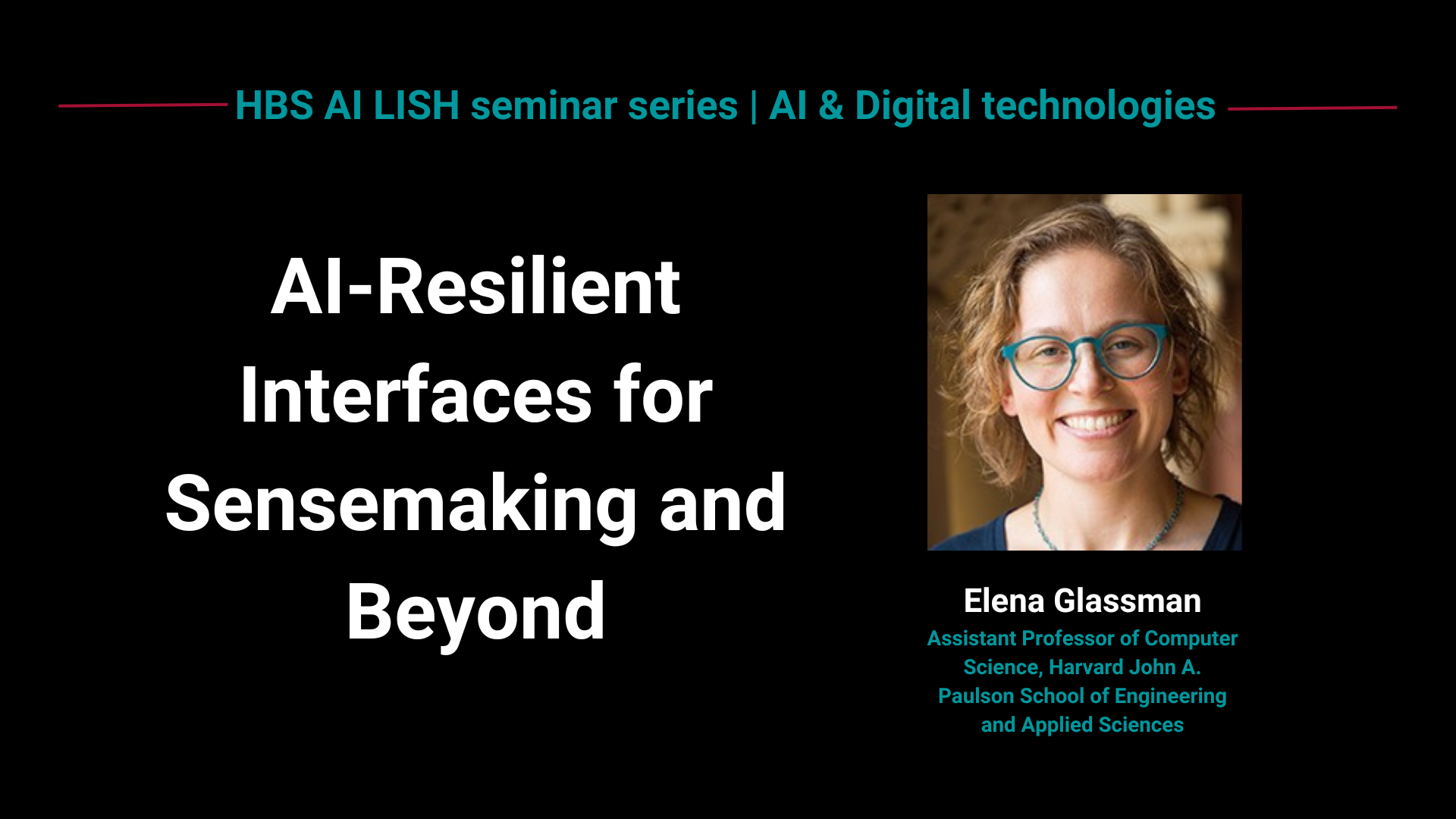
AI-Resilient Interfaces for Sensemaking and Beyond
AI is powerful, but it can be wrong, contextually inappropriate, or subjectively bad—and suppress the user’s critical engagement and learning at the same time. My group is leading a charge to define and refine our understanding of AI-resilient interfaces that help people use AI while (a) maintaining their ability to notice AI choices, e.g., by spurring curiosity and cognitive engagement through surfacing variation in the data and/or the AI’s outputs and (b) giving them the context necessary to evaluate whether those choices are wrong, or at least not right for them. This is critical during context- and preference-dominated open-ended tasks, like ideating, searching, sensemaking, and reading or writing text and code at scale. AI-resilient interfaces improve AI safety, usability, and utility by working with, not against, human perception, attention, and cognition. To achieve this, we are deriving design implications from cognitive science and empirical studies of novel system prototypes, even and especially when these implications fly in the face of common usability guidelines.
Speaker:
Elena Glassman
Assistant Professor of Computer Science, Harvard John A. Paulson School of Engineering and Applied Sciences
Elena L. Glassman is an Assistant Professor of Computer Science at the Harvard John A. Paulson School of Engineering & Applied Sciences, specializing in human-computer interaction. Prior to that, she was a postdoctoral scholar at UC Berkeley, and obtained a BS, MEng, and PhD in Electrical Engineering and Computer Science from MIT. She has been named a Stanley A. Marks & William H. Marks Professor at the Radcliffe Institute for Advanced Study and a National Academy of Sciences Kavli Fellow. Her work has been funded by the NSF, private industry, the Berkeley Institute for Data Science, and the Sloan Research Fellowship. This work has received Best Paper and Honorable Mention awards at top-tier human-computer interaction research venues.
Date and Time:
May 19, 2026 | 1pm- 2pm EST | Hybrid
Location:
SEAS 6th floor, Conference Room 6.301+6.302
Harvard John A. Paulson School of Engineering and Applied Sciences,
Science and Engineering Complex, 150 Western Ave, Boston, MA 02134
Questions? Please contact lish@harvard.edu