

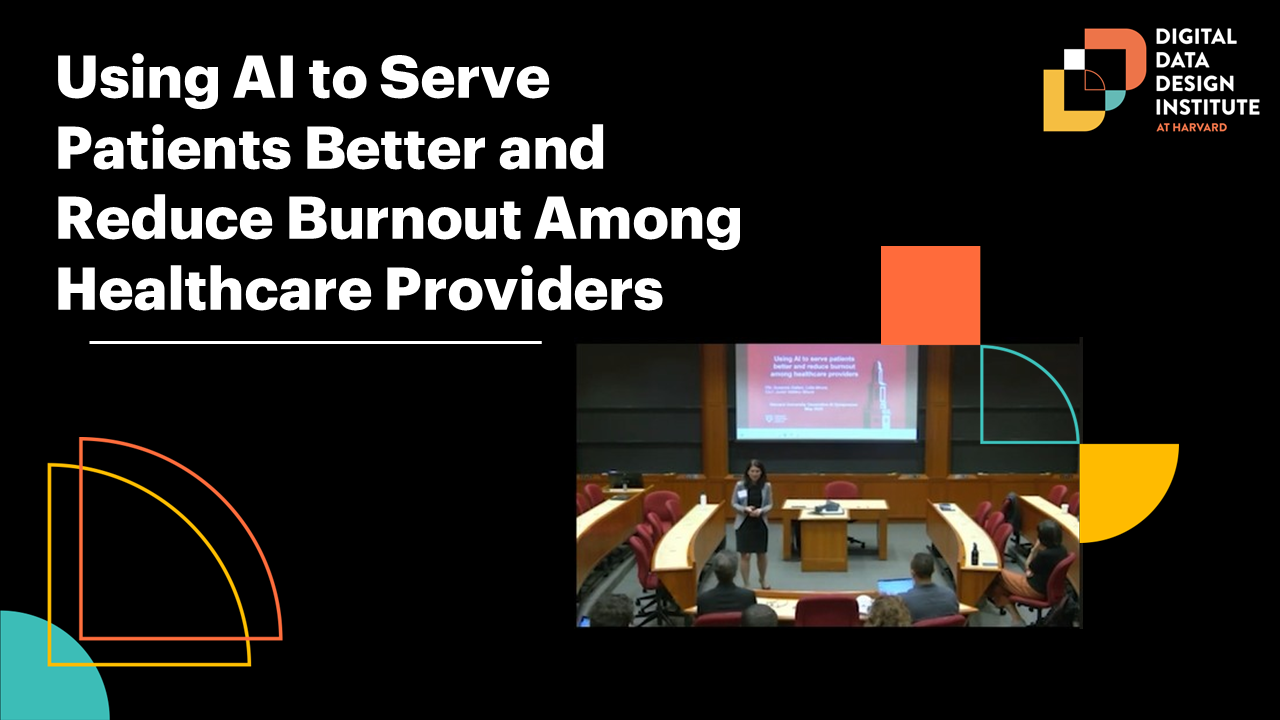
On May 13, 2025, the HBS AI Institute (previously Digital Data Design Institute at Harvard (D^3)) held a university-wide Generative AI Symposium in partnership with the Office of the Vice Provost for Research, the Office of the Vice Provost for Advances in Learning, the Faculty of Arts and Sciences, the Harvard John A. Paulson School of Engineering and Applied Sciences, Harvard University Information Technology and Harvard Library. This half-day event for Harvard faculty, students, and staff focused on the impact of AI on research, teaching, operations, and innovative applications across professional schools and areas of practice.
Innovative solutions are desperately needed to address the problem of burnout in the healthcare industry, and in her session Using AI to Serve Patients Better and Reduce Burnout Among Healthcare Providers, Susanna Gallani, the Tai Family Associate Professor of Business Administration and HBS AI Institute Associate at Harvard Business School, in collaboration with researchers from the Harvard T.H. Chan School of Public Health and Harvard Medical School, presented the findings and future opportunities of using AI to address this critical issue. By focusing on the intersection of AI, healthcare provider burnout, and patient communication, this research offers valuable insights into how technology can transform not only the healthcare landscape, but any field involving the interaction of customers with trained professionals.
Key Insight: The Burnout Crisis in Healthcare
“Everybody that works in healthcare has a high degree of burnout.”
Susanna Gallani
Healthcare burnout is a pervasive issue affecting not just physicians, but all levels of healthcare workers. Traditional and well-documented approaches to addressing burnout have often targeted the healthcare professionals themselves, such as through counseling sessions or yoga. However, in her talk Gallani discussed how a major driver of burnout is not patient care activities or the underlying mental fortitude of healthcare professionals, but the administrative burden that accompanies modern healthcare delivery. Her team has proposed a shift in focus from increasing healthcare-worker resiliency to actively removing the causes of burnout, emphasizing the need for organizational solutions that address the root of the problem.
Key Insight: AI as a Time-Saving Tool for Healthcare Providers
“We’ve never heard the word life-altering, life-changing, life-transforming, as often as we have in this solution.”
Susanna Gallani
Whereas Gallani’s recent article for HBS Working Knowledge covered the overall challenge and economic implications of burnout in the healthcare industry and the general opportunity for AI to be a driver of solutions, her Generative AI Symposium talk focused on two specific AI-driven solutions. The first of these is related to one of the primary sources of burnout for healthcare providers: the time-consuming task of compiling patient notes. Gallani’s team investigated the use of AI-powered ambient listeners, which can record patient-doctor conversations and automatically populate electronic medical records. This technology has the potential to save physicians significant amounts of time, allowing them to focus more on patient care and improving their work-life balance. Gallani reported how the adoption of such AI tools has been described as “life-altering” by many healthcare professionals, indicating the profound impact AI technology can have in the field.
Key Insight: AI-Integrated Messaging Triage
“[S]o that LLM can actually learn about the conditions of this patient and read the notes in the response to the patient.”
Susanna Gallani
Another source of stress and burnout for healthcare providers is the growing volume of healthcare portal messages sent by patients. Gallani discussed how a new AI-powered system trained to respond to patient inquiries could be a game changer. Currently her team’s focus is on building a virtual environment with de-identified patient messages and medical notes to train the AI. It has shown promising results: demonstrating the ability to provide appropriate information instantaneously and even go beyond the initial query by referencing patient history. This approach could particularly assist nurses and nurse practitioners, who often struggle to manage the high volume of patient messages and are thus prevented from providing the personal care delivery they are trained to give.
Why This Matters
For executives and business leaders, AI applications like these represent a critical opportunity to simultaneously address customer experience issues while improving operational efficiency. By automating routine administrative tasks, organizations can redirect staff towards work that better utilizes their expertise and training. The potential return on investment extends to reduced turnover costs, improved satisfaction scores, enhanced communication, and better outcomes overall. As AI technologies advance, organizations that strategically implement them will gain significant competitive advantages in key determinants of long-term organizational success.
About the Speaker

Susanna Gallani is an HBS AI Institute Faculty Associate and the Tai Family Associate Professor of Business Administration in the Accounting and Management unit at Harvard Business School. She collaborates with Harvard Medical School by teaching and co-directing the Health Care Delivery and Leadership module in the required course Essentials of the Profession II. She teaches in the post-graduate medical education programs Surgical Leadership Program and Leadership in Medicine: Southeast Asia. She holds a Ph.D. in Accounting from Michigan State University and a master’s in Business Administration from Central Michigan University.