

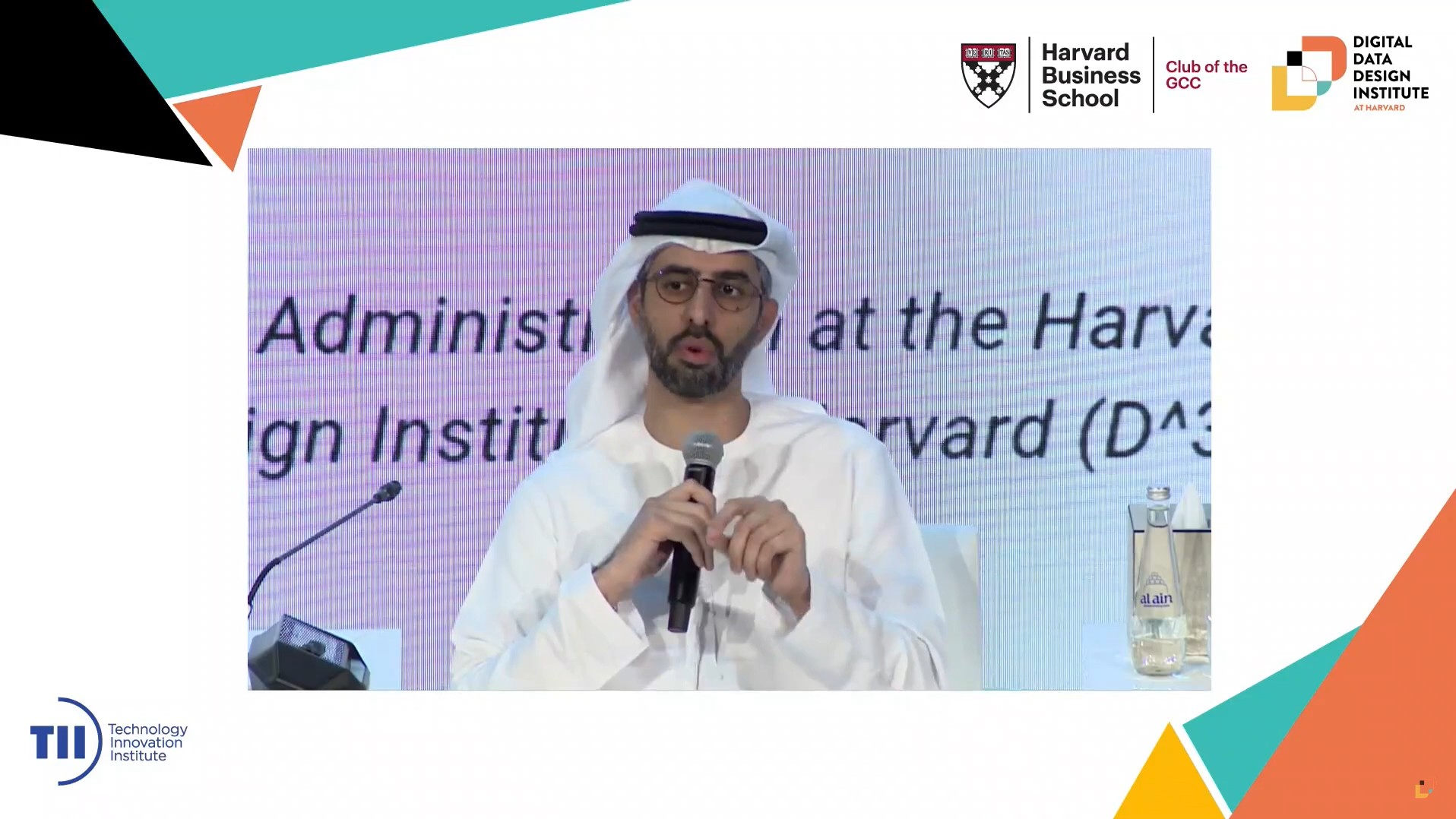
As AI continues to reshape industries globally, the Harvard Business School AI Institute (previously the Digital Data Design Institute at Harvard (D^3)) and the Harvard Business School Club of the Gulf Cooperation Council hosted AI Elevate: From Readiness to Exponential Growth on December 13, 2024, in Dubai, UAE. This one-day conference provided business leaders, researchers, and government officials with crucial insights into AI strategy, industry transformation, and global market integration. For an introduction to the day-long conference, see the Opening Remarks and the Agenda.
In the session UAE: AI Readiness and Exponential Growth, H.E. Omar Sultan Al Olama, the world’s first Minister of State for Artificial Intelligence, sat down with HBS AI Institute co-founder Karim Lakhani for a fireside chat to discuss the UAE’s strategic approach to AI integration and its impact on governance, growth, and quality of life.
Key Insight: History Driving AI Adoption
“An ignorance-based decision to ban something you don’t understand is going to lead to you going backwards.”
H.E. Omar Sultan Al Olama
Al Olama drew an important parallel between today’s AI hesitation and the Middle East’s historic decision to ban the printing press, which sent the region away from global knowledge leadership hundreds of years ago. Concerns about misinformation, loss of control over knowledge production, and fear of unknown consequences – what Al Olama terms ‘ignorance-based decisions’ – are top of mind now because of the uncertainty around AI, but in this case the UAE is aggressively leaning into the new technology, such as by appointing a Minister of State for Artificial Intelligence, and launching more than 147 different applications of AI within the government.
Key Insight: A Dual Track for National Development
“Our development over 50 years was actually a very interesting cycle: we focused on software, so on people and their development, and then we focused on the hardware, which is the buildings, the bridges, the infrastructure, and now we’re going back to focusing on the software, because if you always balance the two, you progress. If you choose to develop one and not the other, you will always fall behind.”
H.E. Omar Sultan Al Olama
This dual approach has been central to the UAE’s growth strategy over the past five decades, with learning and upskilling in AI as only the latest step. For example, over 377 senior government officials recently completed an intensive AI training program, and 2.1 million UAE citizens engaged in prompt engineering for UAE Codes day.
Key Insight: AI for Quality of Life
“We need to dedicate this tool to the improvement of our lives.”
H.E. Omar Sultan Al Olama
Al Olama stressed that AI should be used to enhance people’s quality of life. For example, in Abu Dhabi, traffic lights are connected to an AI hub that optimizes flow, ensuring that the existing infrastructure can maintain efficiency even with population growth. Another example is the use of AI technology in airports, where facial recognition technology allows for a quicker and more seamless experience reducing lengthy waits at checkpoints prevalent elsewhere.
Why This Matters
Al Olama and Lakhani’s conversation provides executives with examples and a strategy for approaching AI adoption and transformation that extends beyond traditional models. The UAE’s experience demonstrates that successful AI implementation requires organizational forethought and commitment, balanced investment in both human and technological capital, and a fundamental reorientation towards human-centered outcomes. By fostering an AI-ready populace, the UAE demonstrates how government, business, and society at large can collaborate to prioritize meaningful outcomes. The UAE’s AI mandate is clear: invest with purpose, lead with clarity, and deploy with empathy.
Meet the Speakers
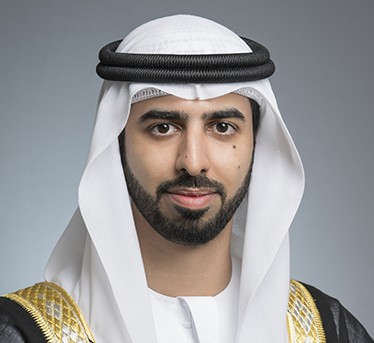
H.E. Omar Sultan Al Olama is the UAE Minister of State for Artificial Intelligence, Digital Economy and Remote Work Applications. He is also Director General of the Prime Minister’s Office at the Ministry of Cabinet Affairs.
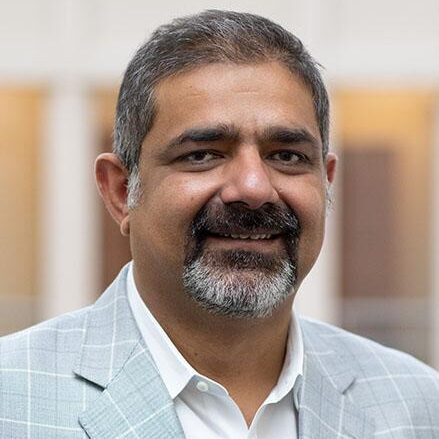
Karim R. Lakhani is the Dorothy & Michael Hintze Professor of Business Administration at Harvard Business School. He specializes in technology management, innovation, digital transformation, and artificial intelligence. He is the Co-Founder and Chair of the HBS AI Institute and the Founder and Co-Director of the Laboratory for Innovation Science at Harvard.