
About
The Climate and Sustainability Impact Lab advances research at the intersection of technology, climate, and sustainability, and how companies can decarbonize.
We are guided by the core research question: What are the best practices and supporting conditions that allow a company to achieve meaningful reductions in its lifecycle emissions or commercialize scalable climate solutions?
Team
Principal Investigators
George Serafeim
 George Serafeim
is Charles M. Williams Professor of Business Administration. He holds a DBA from Harvard University.
George Serafeim
is Charles M. Williams Professor of Business Administration. He holds a DBA from Harvard University.
Michael W. Toffel
 Mike Toffel
is Senator John Heinz Professor of Environmental Management. He holds a PhD from the University of California Berkeley.
Mike Toffel
is Senator John Heinz Professor of Environmental Management. He holds a PhD from the University of California Berkeley.
Peter Tufano
 Peter Tufano
is Baker Foundation Professor. He holds a PhD in Economics from Harvard University.
Peter Tufano
is Baker Foundation Professor. He holds a PhD in Economics from Harvard University.
Faculty
Shirley Lu is Assistant Professor of Business Administration at Harvard Business School.
Christian Kaps is Assistant Professor of Business Administration at Harvard Business School.
Aliya Korganbekova is Assistant Professor of Business Administration at Harvard Business School.
Postdoctoral Fellows
Simon Xu. Simon’s research interests are sustainable finance and corporate social responsibility, with links to financial intermediation, corporate finance, and banking.
Franziska Hittmair. Franziska’s research is in the area of corporate sustainability, with a focus on topics related to corporate environmental pollution and environmental disclosure practices.
Thomas Palley. Tom’s research interests include electric vehicles, energy planning, electric utility investments, renewable energy, electricity markets, and other topics in sustainable operations.
Doctoral Student Affiliates
Trang Nguyen’s research interests are at the intersection of corporate governance and climate disclosure & management. Her research focuses on evaluating firms’ strategies in decarbonization, understanding ESG disclosure, and investigating shareholder actions that influence firms’ climate-related performance.
Srimayi Tenali is interested in corporate climate action and decision-making.
Staff
Christina Jarymowycz
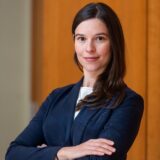 Christina Jarymowycz
is an Assistant Lab Director at the Harvard Business School AI Institute.
Christina Jarymowycz
is an Assistant Lab Director at the Harvard Business School AI Institute.
Project Highlights
Climate Solutions
Lab affiliates: George Serafeim, Shirley Lu, Simon Xu.
Climate change is often viewed as a risk, but it is also a driver of innovation. This project adopts a business opportunity perspective by exploring Climate Solutions—products and services that foster the transition to a low-carbon economy. Examples include solar panels, wind turbines, electric vehicles, battery storage, heat pumps, energy efficient equipment and buildings, and plant-based food products.
We utilize Large Language Models to analyze financial filings, identifying how firms and industries advance climate solutions. This measure of climate solutions allows us to address several crucial questions: What are the risks and financial implications for firms engaging in climate solutions? How do firms that transition their product portfolio towards climate solutions attract and develop the human capital needed to lead a product portfolio transition? What role do different capital providers play in incentivizing or disincentivizing such transitions?
Energy Transition in Transportation
Lab affiliates: Christian Kaps, Michael W. Toffel, Thomas Palley.
This research is analyzing how the electric vehicle charging infrastructure is evolving and can be optimized to reduce cost and climate impacts via smarter one-way charging (V1G) and two-way charging (V2G). This workstream includes a case study (with teaching note), and several ongoing scholarly research projects using telemetry data from an automotive original equipment manufacturer (OEM).
Electric Vehicle Charging Service Reliability
Lab affiliates: Michael W. Toffel
This research aims to understand and improve the operational reliability of public electric vehicle (EV) charging stations in the U.S., which is typically offered as a supplementary service by service companies such as hotels, retailers, and parking facilities. The project examines the role of market competition from different types of EV charging stations. Using large language models with expert-in-the-loop prompting, the study analyzes hundreds of thousands of user reviews to measure charging reliability as experienced by drivers, rather than relying on technical specifications or self-reported metrics.
This study seeks to help policymakers and industry stakeholders make informed decisions about funding allocations and operational improvements to enhance the effectiveness of EV charging infrastructure. This project is a collaboration with Georgia Institute of Technology’s Yifan Liu and Omar I. Asensio (former HBS BIGS Fellow).
Related Article: The state of EV charging in America: Harvard research shows chargers 78% reliable and pricing like the ‘Wild West’, Institute for Business in Global Society, Harvard Business School.
Voluntary Carbon Markets
Lab affiliates: Michael W. Toffel, Franziska Hittmair.
Voluntary carbon markets, which entail the creation and trading of carbon credits, represent an important opportunity to foster decarbonization at a lower cost than relying solely on internal corporate efforts. Many companies plan to use carbon credits to meet their net zero targets, but persistent challenges, including measurement, permanence, and additionality, have led to major questions about the viability of this market. This workstream includes a Harvard Business Review primer on carbon credits, as well as a case study (with teaching note) and a podcast episode on the carbon credit rating agency Calyx Global, and ongoing research by Mike Toffel and Franziska Hittmair on how media scandals are affecting supply and demand for carbon credits.
Data Commons
The Data Commons shares and describes datasets about climate and sustainability to support researchers creating scholarship with data. In this database, each dataset is labeled with information on coverage, resolution, usage, and variables, and may be browsed by categories including Emissions and Air Pollution, Company Disclosures, and more.
You may share a dataset for us to include in the resource.
Working Conditions in Supply Chains
This micro website produced by Mike Toffel and the HBS Baker Library provides 45+ actionable summaries of academic research focused on improving working conditions in supply chains conducted by scholars from 20+ universities.
We aim for this resource to provide actionable insights for managers, practitioners, and organizations to assess and improve working conditions in supply chains.
Publications
Articles and Working Papers:
Climate Alliances
To Earn Trust, Climate Alliances Need to Improve Transparency by Peter Tufano, Chris Thomas, Knut Haanaes, Matteo Gasparini, Robert Eyres, and Chris Chapman, Harvard Business Review, November 2023.
Transparent Climate Alliances: Principles for Greater Effectiveness and Legitimacy by Peter Tufano, Chris Thomas, Knut Haanaes, Matteo Gasparini, Robert Eyres, and Chris Chapman, Social Science Research Network (SSRN), July 2023.
Circular Economy
How AI Will Accelerate the Circular Economy by Shirley Lu and George Serafeim, Harvard Business Review, June 2023.
Circular Products and Business Models: Opportunities for Entrepreneurs, Managers, and Investors by Shirley Lu and George Serafeim, Social Science Research Network (SSRN), May 2023.
Climate Finance
The Evolving Academic Field of Climate Finance by Matteo Gasparini and Peter Tufano, Harvard Business School Working Paper, No. 23-057, January 2023.
Climate Solutions
Lab affiliates: George Serafeim, Shirley Lu, Simon Xu.
Catalysts for Climate Solutions: Corporate Responses to Venture Capital Financing of Climate-tech Startups by Shirley Lu, George Serafeim, and Simon Xu, Harvard Business School Working Paper, No. 25-025, November 2024.
Climate Solutions, Transition Risk, and Stock Returns.” by Shirley Lu, Edward J. Riedl, Simon Xu, and George Serafeim, Harvard Business School Working Paper, No. 25-024, November 2024.
Course Materials:
Circular Economy
Apple’s iPhone Revolution: Pioneering the Circular Economy by George Serafeim, Harvard Business School Case 123-089, April 2023. (Teaching Note available.)
Vytal: Packaging-as-a-Service by George Serafeim, Michael W. Toffel, Lena Duchene, and Daniela Beyersdorfer, Harvard Business School Case 124-007, July 2023. (Teaching Note available)
Climate Finance
Aviva plc: Examining Net Zero by Peter Tufano, Brian Trelstad, Matteo Gasparini, Harvard Business School Case 324-008, November 2023.
Forecasting Climate Risks: Aviva’s Climate Calculus by Mark Egan and Peter Tufano, Harvard Business School Case 224-025, September 2023. (Teaching Note available)
Business Models
Seeds of Innovation: GALY’s Quest to Cultivate the Future of Agriculture in the Lab by George Serafeim and Michael Norris, Harvard Business School Case 124-017, September 2023 (Revised November 2023). (Teaching Note available)
AI and Climate Change
Climate Change Adaptation with Artificial Intelligence and Machine Learning. by Michael W. Toffel, and Nabig Chaudhry Harvard Business School Background Note 625-050, April 2025.
Mitigating Climate Change with Machine Learning by Michael Toffel, Kelsey Carter, Amy Chambers, Avery Park, and Susan Pinckney, Harvard Business School Background Note 625-014, August 2024.
Programs and Events:
AI and Climate Change Short Intensive Program
Co-led by Michael W. Toffel and John Mulliken, this Short Intensive Program explores how artificial intelligence and machine learning can accelerate both climate mitigation and adaptation as well as the strategic, investment, and entrepreneurship opportunities emerging at this intersection. Drawing on the premise that climate adaptation and mitigation will require substantial investment over the coming decades, the program examines where AI can be a “multiplier” that helps solutions scale fast enough to matter, while also grappling with the tradeoffs posed by AI’s own energy and resource demands.
Net Zero Systems Solutions Roundtable: Fleet Electrification
This workshop hosted by Harvard Business School and the Environmental Defense Fund in May 2024 joined representatives of shippers and carriers to surface challenges and best practices to accelerate the decarbonization of cargo trucking.
The Circular Revolution D^3 Catalyst [1]
The Circular Revolution D^3 Catalyst in April 2023 was hosted to highlight the impacts and opportunities of circular economy. The event was attended by 100+ participants, experts, and industry leaders, and resulted in Harvard Business School article titled How AI Will Accelerate the Circular Economy, a white paper titled Circular Products and Business Models: Opportunities for Entrepreneurs, Managers, and Investors, and two HBS teaching cases Apple’s iPhone Revolution: Pioneering the Circular Economy and Seeds of Innovation: GALY’s Quest to Cultivate the Future of Agriculture in the Lab.
Podcasts
Digital, AI, and IoT applications to address climate change
How BCG Uses AI to Address Climate Change featuring Hamid Maher and Charlotte Degot (March 1, 2023)
Google’s AI Approach to Climate Change featuring Yossi Matias (March 15, 2023)
Weavegrid’s AI Solution for EV-to-Grid Integration featuring Apoorv Bhargava (March 29, 2023)
Ideon: Mining the Energy Transition featuring Gary Agnew and Kim Lawrence (April 12, 2023)
Climate Adaptation & Supply Chains: Everstream Analytics’ AI Solution featuring Jim Hayden (April 26, 2023)
How OPower Uses Behavioral Science & AI to Reduce Energy Demand featuring Paul McDonald (May 10, 2023)
Using AI to Optimize Energy Demand featuring Sagewell CEO Pasi Miettinen (Nov 20, 2024)
Using AI to Fight Wildfires: How Dryad Networks is Scaling Climate Technology featuring Dryad CEO Carsten Brinkschulte (Dec 4, 2024)
Using AI and Satellite Data to Transform Agriculture: A Conversation with Alyssa Whitcraft, co-founder NASA Harvest, co-founder Harvest SARA, University of Maryland professor (Dec 18, 2024)
Accelerating Battery Innovation with AI: A Conversation with Argonne’s Logan Ward, Deputy Scientist at Argonne National Laboratory (Jan 1, 2025)
Contact Us
You can reach us by contacting Christina Jarymowycz.
[1] Please note: The Digital Data Design Institute at Harvard (D^3) was renamed the HBS AI Institute in April 2026.